Yeosu Travel Guide: Night Sea, Cable Cars & Korea's Best Seafood (2026)
There's a Korean pop song from 2012 called "Yeosu Night Sea" (여수 밤바다) by Busker Busker that single-handedly turned this small southern coastal city into one of Korea's most popular domestic destinations. That's not an exaggeration. Before the song and the 2012 World Expo, Yeosu was a quiet fishing port that most Koreans associated with fresh seafood and not much else. After? It became the romantic getaway — the place couples go to walk along the waterfront at night, ride a cable car over the ocean, and eat raw crab marinated in soy sauce until they can't move.
Yeosu sits on the southern coast of Jeollanam-do province, wrapped around a series of peninsulas and islands that jut out into the South Sea. The geography is dramatic — craggy coastlines, forested islands connected by bridges, and water that catches light differently at every hour of the day. It's not a big city (population around 280,000), and it doesn't try to be. What Yeosu does well is atmosphere: the smell of salt and grilling shellfish, the glow of Dolsan Bridge reflected in the harbor at night, the sound of waves hitting the rocks below Hyangiram Hermitage at dawn.
I came for the night sea and the seafood. I left understanding why Koreans keep coming back. This guide covers everything you need to plan your trip — from the famous night sea to the crab alleys, the clifftop hermitage to the practical details that make the difference between a good trip and a great one.
If you're new to Korea, start with that guide for the basics. If you're building a broader itinerary, check the Korea itinerary planner to see where Yeosu fits.
Where to stay & what to book
Yeosu has a small but solid lodging mix. Around the 2012 Expo area, Ramada Plaza by Wyndham Yeosu is the easiest international-standard pick — quiet at night, a short drive to the cable-car base. Hotel Kenny Yeosu sits in the old harbor near the food alleys; basic but you wake up close to the markets. Budget travelers head to Backpackers In Yeosu by the bus terminal. For something Korean-traditional, the Yeosu Hanok Experience Center offers hanok stays, though booking goes through their own channel rather than the usual aggregators.
Easy to compare options: Yeosu hotels on Booking · Yeosu tours on Klook
Korea Insider may earn a small commission from links above at no extra cost to you.
Why Yeosu
Yeosu doesn't compete with Seoul for culture or Busan for beaches. It occupies its own category entirely — a coastal city where the water, the food, and the mood are the main attractions. Here's why it's worth the trip south:
- The night sea atmosphere — Yeosu's waterfront after dark is genuinely special. The harbor lights, the illuminated Dolsan Bridge, the buskers along the promenade, the couples sitting on the seawall eating grilled shellfish — it has an energy that's romantic without being contrived. There's a reason Busker Busker's song resonated so deeply with Koreans.
- Korea's best seafood, and it's not close — Yeosu and the surrounding South Sea coast are where Korea's seafood obsession reaches its peak. The gejang (raw crab in soy sauce) here is legendary. The sashimi is cut from fish that were swimming hours ago. The grilled shellfish restaurants along the waterfront serve clams, abalone, and scallops at prices that would make a Seoul restaurant owner weep.
- Ocean cable car — The Yeosu Haeseang Cable Car crosses open ocean between the mainland and Dolsan Island. It's not just a transport novelty — the views are spectacular, especially at sunset when the water below turns gold and the islands scatter across the horizon.
- Dramatic coastal geography — Between Odongdo Island's camellia forests, Hyangiram Hermitage clinging to sea cliffs, and Dolsan Bridge arching over the harbor, Yeosu packs serious visual punch into a compact area. This isn't flat coastline — it's rugged, layered, and constantly photogenic.
- Expo legacy infrastructure — The 2012 World Expo left Yeosu with excellent waterfront infrastructure: wide promenades, public spaces, a musical fountain, and an aquarium. The city punches well above its weight class in terms of things to do per square kilometer.
- Genuinely affordable — A massive seafood spread for two runs ₩40,000–₩60,000. Gejang sets start at ₩15,000. Accommodation outside peak season is ₩60,000–₩100,000 for a decent room with a sea view. Compared to Busan or Jeju, Yeosu delivers more for less.
Yeosu is also one of the warmest places in mainland Korea, thanks to its southern coastal position and the warm Kuroshio Current. Winters are mild by Korean standards (rarely below freezing), and the sea temperatures are swimmable from June through September. Spring brings camellias to Odongdo, autumn brings clear skies and spectacular light, and summer brings... crowds, honestly. Time your visit accordingly.
If you're doing a Busan trip, Yeosu makes an excellent 2-day add-on. The two cities are about 2 hours apart by bus, and the contrast — Busan's urban beach energy vs. Yeosu's intimate harbor calm — makes them complement each other perfectly.
Getting to Yeosu
Yeosu is further south than most tourists venture, but getting there is straightforward. The KTX connection changed everything — what used to be a grueling 5+ hour bus ride from Seoul is now a direct high-speed train through some of Korea's most beautiful countryside.
KTX from Seoul (Recommended)
The KTX from Seoul Yongsan Station to Yeosu-Expo Station takes approximately 2 hours 40 minutes to 3 hours. Tickets cost around ₩46,800 one-way for standard class. Trains run several times daily, with more frequent service on weekends and holidays.
Important: The station is called Yeosu-Expo (여수엑스포), and it's located right next to the Expo site and waterfront area — arguably the most conveniently located KTX station in all of Korea for tourists. You can literally walk from the platform to the ocean cable car in 10 minutes. No taxi needed.
Book at letskorail.com or through the Korail Talk app. Weekend trains fill up fast, especially during summer and the October–November foliage season. Book at least 3–5 days ahead for weekend travel.
Scenic tip: Sit on the left side of the train heading south. The last 30 minutes of the journey wind through coastal mountains with occasional ocean glimpses that get more dramatic as you approach Yeosu. It's one of the prettiest KTX approaches in the country.
Express Bus
Express buses from Seoul Express Bus Terminal (Central City, Gangnam) to Yeosu Express Bus Terminal run roughly every 30–60 minutes. The ride takes about 3 hours 40 minutes to 4 hours. Tickets cost around ₩23,500 for standard (일반) or ₩34,700 for premium (우등). Premium is worth it for a journey this long.
Book at bustago.or.kr. The bus terminal is about a 15-minute taxi ride (₩6,000–₩8,000) from the waterfront area.
From Busan
This is the route most travelers care about. Express buses from Busan Sasang Bus Terminal to Yeosu run frequently and take about 2 hours to 2 hours 30 minutes. Tickets cost around ₩16,200. There are also intercity buses from Busan Central Bus Terminal (Nopo-dong) that take a bit longer but offer more departure times.
Alternatively, you can take the KTX from Busan Station, but it requires a transfer at Suncheon and actually takes longer than the direct bus. The bus is the better option from Busan.
From Jeonju
If you're combining Yeosu with a Jeolla province loop, intercity buses from Jeonju to Yeosu run several times daily and take about 2 hours 30 minutes to 3 hours (₩16,500). You'll pass through Suncheon, which itself is worth a stop for the Suncheon Bay wetlands.
Flying
Yeosu Airport (RSU) has domestic flights from Seoul Gimpo on Korean Air and Jin Air. Flight time is about 55 minutes, and round-trip tickets run ₩100,000–₩180,000 depending on when you book. The airport is 20 minutes from the city center by taxi (₩12,000–₩15,000). Flying makes sense if you're short on time and book early for a good fare, but the KTX is more practical for most travelers.
Getting Around Yeosu
Yeosu's main tourist attractions are concentrated in a relatively small area around the waterfront and Dolsan Island. You can walk between the Expo area, cable car, and Odongdo Island. For Hyangiram and more distant spots, you'll need taxis or local buses. Taxis are cheap and plentiful — most rides within the city cost ₩4,000–₩8,000. Use Naver Map for bus routes and walking directions.
If you want more flexibility, renting a car opens up the beautiful coastal roads and smaller islands. But for a first visit focused on the main sights, you really don't need one.
Yeosu Night Sea
This is it. The thing that put Yeosu on the map. "Yeosu Night Sea" (여수 밤바다) isn't just a song title — it's an entire experience that has become shorthand for a specific type of Korean romance: walking along the waterfront after dark, the harbor lights reflecting off the water, eating something warm from a street vendor, feeling the sea breeze.
The Waterfront Promenade
The main night sea experience centers on the waterfront promenade that runs from the Expo area east toward Jasan Park. This stretch — roughly 2 kilometers — is where everything happens after sunset. The walking path is wide, well-lit, and lined with:
- Grilled shellfish restaurants — Open-front places with tanks of live clams, mussels, scallops, and abalone. You pick your seafood, they grill it on the spot. The smell alone is worth the walk.
- Buskers and street performers — Especially on weekend evenings, musicians set up along the promenade. The quality varies, but the atmosphere they create is consistently good.
- The Dolsan Bridge view — The bridge is illuminated at night with changing LED colors — blue, purple, green, gold — reflected in the harbor below. It's the backdrop for approximately 90% of all Yeosu Instagram photos, and honestly, it earns every one of them.
- Street food vendors — Hotteok, tteokbokki, grilled squid on sticks, and Yeosu's own specialty: kkul-ppang (honey bread), a sweet fried bread that's become the city's signature snack. You'll see the shops everywhere.
Jasan Park (자산공원)
For the best elevated view of the night sea, climb up to Jasan Park. It's a short but steep walk from the waterfront (about 10 minutes uphill), and the panoramic view from the top takes in the entire harbor — Dolsan Bridge, the cable car crossing, the city lights, and the dark mass of Dolsan Island beyond. There's a pavilion at the top with benches. Bring a drink and stay awhile.
The "Yeosu Night Sea" song monument is near the waterfront below Jasan Park. It's exactly as cheesy as you'd expect — a stone with the song lyrics — and couples line up to take photos in front of it. Don't fight it. Take the photo.
When to Go
The night sea experience peaks between about 7 PM and 11 PM. Fridays and Saturdays are the busiest — the promenade gets genuinely crowded during summer weekends and holidays. For a more peaceful experience, visit on a weekday evening. The view is exactly the same, minus the crowds.
The atmosphere is best in spring (April–May) and autumn (September–October), when the temperatures are comfortable for extended walking and the air is clear enough for good visibility. Summer is hot and humid but has the longest hours of warmth. Winter evenings are beautiful but cold — bundle up and the harbor lights feel even more atmospheric against the dark, crisp sky.
Haeseang Cable Car
The Yeosu Haeseang Cable Car (여수 해상 케이블카) is the first ocean-crossing cable car in Korea, and it remains one of the most visually stunning. The ride connects the mainland (near the Expo area) to Dolsan Island, crossing about 1.5 kilometers of open sea at a height of up to 70 meters above the water. On a clear day, you can see scattered islands stretching toward the horizon in every direction.
The Experience
There are two cabin types:
- Regular cabin — Standard enclosed gondola seating 8 people. ₩15,000 one-way / ₩22,000 round-trip for adults.
- Crystal cabin (transparent floor) — Same ride, but the floor is glass. You look straight down at the ocean 70 meters below. ₩22,000 one-way / ₩33,000 round-trip for adults. The crystal cabin costs more and has longer wait times, but if you're not afraid of heights, it transforms the experience. Looking down at fishing boats passing directly beneath your feet while suspended over open ocean is genuinely thrilling.
The ride takes about 13 minutes each way. At the Dolsan Island end, there's an observation deck and some walking paths along the cliff edge with ocean views. Most people ride round-trip and spend 20–30 minutes exploring the Dolsan side before heading back.
Best Time to Ride
Sunset. Time your ride so you're crossing the water as the sun drops toward the islands. The light turns the sea surface gold, then pink, then deep purple — and the transition from daylight views to the illuminated night landscape below is spectacular. The cable car operates until 9:30 PM (10 PM on weekends in summer), so evening rides with the city lights below are also excellent.
Wait times during peak season (summer weekends, holidays) can exceed 60–90 minutes. Weekday mornings have the shortest waits. If you're visiting on a weekend, arrive early or go late — the mid-afternoon rush is brutal.
Tip: Buy tickets online in advance at the Yeosu Cable Car website or via the Klook app to skip the ticket queue, though you'll still wait for a cabin during busy times.
Weather Closures
The cable car closes during high winds, heavy rain, and typhoon warnings. This is more common than you'd think — Yeosu's coastal position means wind is a regular factor, especially in winter and during typhoon season (July–September). Check the operating status before heading over. Nothing ruins a plan faster than arriving to find the cable car shut down.
Dolsan Bridge & Dolsan Park
Dolsan Bridge (돌산대교) is Yeosu's most recognizable landmark — a 450-meter cable-stayed bridge connecting the mainland to Dolsan Island, illuminated at night with LED lights that cycle through colors. It's been the defining image of Yeosu since it opened in 1984, long before the Expo or the cable car existed.
Viewing the Bridge
You can walk across Dolsan Bridge, but the best experience is viewing it from a distance at night. The top spots:
- Dolsan Park (돌산공원) — On the Dolsan Island side, this hillside park gives you the classic elevated view of the bridge with the Yeosu city lights behind it. There's a large observation deck and a famous "Geobukseon" (turtle ship) sculpture. The park is free and open 24 hours. It's a 10-minute taxi ride from the Dolsan end of the cable car.
- The waterfront promenade — From the mainland side, walking along the harbor gives you the bridge at eye level with its reflection stretching across the water.
- Jasan Park — The elevated view from here captures the bridge as part of the wider harbor panorama.
Dolsan Island
Most tourists see Dolsan only from the bridge or cable car, but the island itself has several worthy stops:
- Hyangiram Hermitage — The big one. Covered in its own section below.
- Dolsan galchi-jorim restaurants — The road leading from Dolsan Bridge is lined with restaurants specializing in braised hairtail fish (갈치조림), one of Yeosu's signature dishes.
- Musulle Beach — A small, quiet beach on the south side of Dolsan, popular with locals in summer. Not a major attraction, but pleasant if you want sand and calm water without Busan-level crowds.
- Coastal drive — The road around Dolsan's perimeter has ocean views at almost every turn. If you have a rental car, it's a beautiful hour-long loop.
Odongdo Island
Odongdo (오동도) is a small island — barely 700 meters across — connected to the Yeosu mainland by a 768-meter causeway. It's one of those places that over-delivers relative to its size. The island is famous for its camellia trees (about 3,000 of them), which bloom in vivid red from January through March, turning the island into one of Korea's earliest spring destinations.
Getting There
Walk along the causeway from the mainland parking area. The walk takes about 10 minutes and is pleasant in itself — ocean on both sides, fishing boats in the harbor. There's also a small tourist train (dongbaek yeolcha) that runs along the causeway for ₩1,000 if you don't feel like walking.
On the Island
Odongdo is a loop walk. The main trail circles the island in about 40–50 minutes at a relaxed pace, passing through:
- Camellia forest — Dense groves of camellia trees that create a canopy overhead. During bloom season (January–March), fallen red petals carpet the paths. Even outside bloom season, the evergreen forest is lush and peaceful.
- Yonggul Cave — A natural sea cave at the island's southern tip. Waves crash into it dramatically, and the sound echoes off the rock walls. There's a viewing platform — get there at high tide for the best effect.
- Lighthouse and observatory — At the island's highest point, a white lighthouse with an observation deck gives panoramic views over the South Sea. On clear days, you can spot islands stretching toward Geoje and beyond.
- Coastal rock formations — The eastern and southern shores have dramatic basalt-like rock formations meeting the sea. Several viewing platforms let you get close to the edge.
Odongdo is free to enter and open year-round. It's most crowded during camellia season and summer weekends. For the best experience, visit on a weekday morning when the trails are quiet and the light filtering through the camellia canopy is at its best.
Tip: The causeway area has several decent seafood restaurants and street food stalls. The grilled shellfish carts here are cheaper than the ones along the main waterfront, and just as fresh.
Expo 2012 Legacy
Yeosu hosted the 2012 World Expo with the theme "The Living Ocean and Coast." Unlike some Expo cities that let their sites decay afterward (looking at you, various abandoned Expo pavilions worldwide), Yeosu actually maintained and repurposed its Expo infrastructure into a genuinely useful waterfront district.
What's Still There
- Big-O (빅오) — The Expo's centerpiece is a massive circular structure sitting in the harbor that hosts a nightly multimedia show — water jets, fire effects, lasers, and projected animations. Shows run at set times after sunset (check locally for the current schedule, as it varies by season). Free to watch from the waterfront promenade. It's impressive even if you're not usually a "multimedia show" person.
- Aqua Planet Yeosu (아쿠아플라넷 여수) — One of Korea's better aquariums, built for the Expo and still operating. The main tank is enormous, and the beluga whale exhibit draws big crowds. Adult admission around ₩29,000. Worth it if you're traveling with kids or genuinely enjoy aquariums, skippable otherwise.
- Sky Tower — A 67-meter observation tower at the Expo site. ₩6,000 for adults. The view overlaps significantly with what you get from the cable car, so if you're doing both, you can skip this one.
- Expo Ocean Park — The surrounding area has been converted into a pleasant waterfront park with wide walkways, public art, and the musical fountain (shows several times daily). It's the starting point for the cable car and connects directly to the night sea promenade.
The Expo area is where most visitors to Yeosu will spend a significant chunk of their time, simply because it connects to everything — the cable car, the waterfront walk, the night sea restaurants, and the path to Odongdo. It functions as Yeosu's de facto city center for tourists.
Hyangiram Hermitage
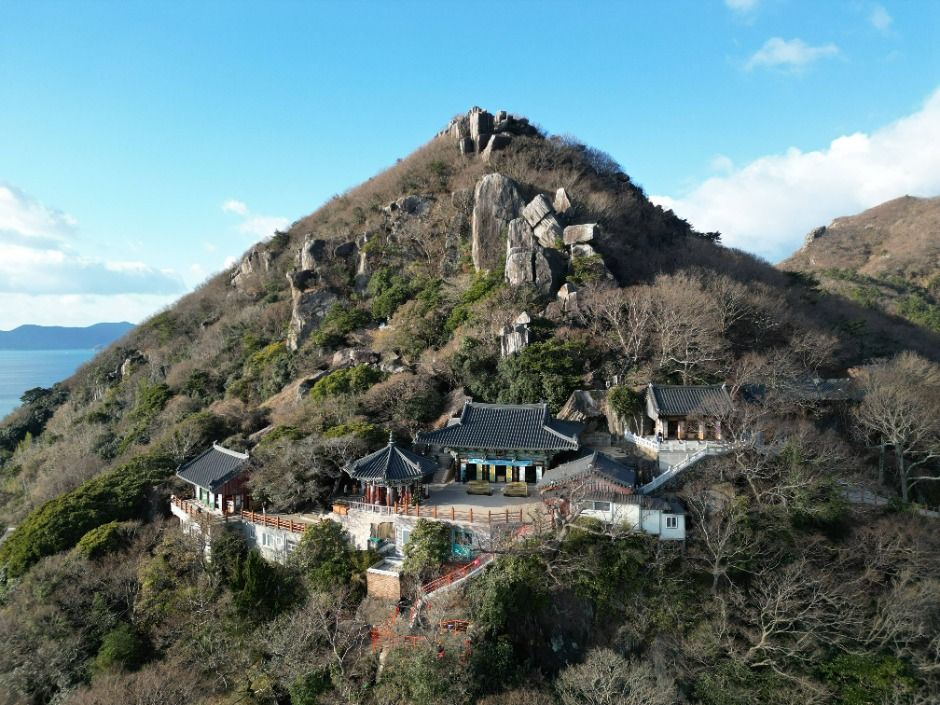
Hyangiram (향일암) is a Buddhist hermitage perched on the rocky cliffs at the southern tip of Dolsan Island, overlooking the open South Sea. The name means "Hermitage Facing the Sun," and it's one of the four famous ocean-sunrise spots in Korea. It's also one of the most dramatically situated temples you'll find anywhere in the country — clinging to raw rock faces, with narrow passages carved through boulders and trees growing out of cracks in the cliff.
Getting There
From central Yeosu, Hyangiram is about 30 minutes by car or taxi (₩15,000–₩20,000 one-way). Local bus 111 runs from Yeosu bus terminal to Hyangiram, taking about 50 minutes. You can also drive across Dolsan Bridge and follow the coastal road south.
From the parking area, it's a 15–20 minute uphill walk to the hermitage. The path is steep in places — stairs cut into rock, narrow passages between boulders that require some squeezing (anyone significantly larger than average Korean body size should be aware that a couple of the rock passages are genuinely tight). Wear proper shoes, not sandals.
The Hermitage
Hyangiram dates back to 644 AD, making it over 1,300 years old. The current structures are reconstructions (fires and wars have taken their toll over the centuries), but the site's power comes from its location, not its architecture. Key elements:
- The rock passage — Getting to the main temple requires passing through a narrow gap between two massive boulders. It's tight enough that you need to turn sideways in places. According to tradition, passing through purifies the visitor. Whether or not you buy the spiritual angle, it's a memorable physical experience.
- The ocean viewpoint — From the hermitage terrace, the view is straight out to the South Sea with nothing between you and the water except cliff and sky. On a clear morning, the sunrise from here is considered one of the best in Korea — it's mobbed on New Year's Day.
- The camellia and pine forest — The trail passes through old-growth camellias and twisted coastal pines that give the whole approach an ancient, wild feeling that's very different from the manicured temple grounds you find elsewhere in Korea.
Admission is ₩2,000 for adults. The hermitage is open from 6 AM to 6 PM (extended to 7 PM in summer). For sunrise, arrive well before dawn — the parking area fills up early, especially on weekends.
My recommendation: If you only have time for one "nature attraction" in Yeosu, make it Hyangiram. Odongdo is pleasant but Hyangiram is unforgettable. The combination of the climb, the rock passages, the ancient site, and the sudden reveal of the ocean view at the top is one of the best sequences of any attraction in southern Korea.
Yeosu Food Guide
This is where Yeosu gets serious. The city sits at the heart of Korea's richest fishing grounds — the South Sea, where warm and cold currents meet, producing an absurd diversity of marine life. The seafood here isn't "good for a small city." It's some of the best in Korea, period. Koreans know this, which is why food is consistently the number-one reason domestic tourists give for visiting Yeosu.
Gejang (게장) — Raw Crab in Soy Sauce
If Yeosu has a single must-eat dish, it's gejang — raw blue crab marinated in soy sauce (간장게장, ganjang-gejang) or spicy chili sauce (양념게장, yangnyeom-gejang). The soy sauce version is the classic: whole crabs soaked for days in a sweet-savory soy marinade until the raw flesh turns silky and intensely flavorful. You crack the shell and suck out the meat, then pour rice into the remaining sauce and mix it with the crab juices. That rice — "dodurak-bap" — is arguably the best part.
Yeosu's gejang is famous across Korea because the local crabs are fresher and the marinades have been perfected over generations. The "gejang alley" (게장골목) near the Yeosu traditional market is where most locals go. Sets start around ₩15,000–₩20,000 per person and typically include several crabs plus a spread of banchan. For higher-end experiences with premium crab, expect ₩30,000–₩50,000.
First-timer tip: Go for ganjang (soy sauce) gejang first. The flavor is more nuanced and it's the version that makes Yeosu famous. If you love raw seafood and aren't squeamish about sucking meat from a crab shell, this might become the best thing you eat in Korea. Check the Korean food guide if you want to understand the broader food culture before diving in.
Galchi-jorim (갈치조림) — Braised Hairtail Fish
Galchi (hairtail or cutlassfish) is a long, silvery fish that's a staple of Korean home cooking. In Yeosu, it's elevated to an art form. Galchi-jorim is the fish braised in a spicy, slightly sweet red pepper sauce with daikon radish and vegetables. The flesh is delicate and flaky, the sauce is rich and complex, and the radish absorbs all those flavors and becomes the stealth star of the dish.
The Dolsan galchi-jorim restaurants — clustered along the road immediately after crossing Dolsan Bridge — are the established destination for this dish. Sets for two start around ₩30,000–₩40,000 and are enormous. Some restaurants bring out a pot with three or four whole fish plus sides. You will not leave hungry.
Grilled Shellfish (조개구이)
This is the quintessential Yeosu night sea food. The waterfront restaurants display tanks full of live shellfish — cockles, mussels, scallops, oysters, abalone, and various clams — and you choose what you want. They bring a gas grill to your table, pile on the shellfish, and you eat them as they pop open from the heat, dipping them in sesame oil, soy sauce, or spicy cho-gochujang.
A basic grilled shellfish set for two costs ₩30,000–₩50,000 depending on what you order. Adding abalone (전복) bumps the price up but is absolutely worth it — grilled abalone with butter and a splash of soy sauce is one of those simple-yet-perfect foods. Pair it with soju and the harbor view and you've got the peak Yeosu experience.
The waterfront promenade restaurants are the obvious spot, but they charge a premium for the location. For better value with the same quality, look for the shellfish restaurants one or two streets back from the waterfront.
Fresh Sashimi (회, hoe)
The Yeosu fish market area and the restaurants around the port serve some of the freshest sashimi (hoe) in Korea. The standard order is a "modeum-hoe" (모듬회) — an assorted platter of whatever's freshest that day, which might include flatfish (광어), sea bream (도미), rockfish (우럭), octopus, and more. Small platters start around ₩30,000, large ones for sharing run ₩50,000–₩80,000.
The sashimi comes with the full Korean accompaniment: sesame leaves for wrapping, raw garlic, green chili peppers, ssamjang (dipping paste), and chogochujang (spicy vinegar sauce). After the sashimi, most restaurants will take the remaining fish bones and make maeuntang (매운탕) — a fiery fish soup that's the perfect final course.
For the market experience, head to Yeosu Susan Market (여수수산시장) in the morning. You can buy fish directly from vendors on the first floor and take it to restaurants on the upper floor to have it prepared. The markup is minimal, and the experience of choosing your own fish is part of the fun.
Other Yeosu Specialties
- Seo-dae hoe (서대회) — Raw tonguefish, a Yeosu specialty that's hard to find elsewhere. The fish is thinly sliced and served with a vinegar-based sauce. It's mild, slightly sweet, and a good gateway for people who are new to raw fish.
- Kkul-ppang (꿀빵) — Yeosu's signature snack: deep-fried bread filled with sweet red bean paste and drizzled with honey. Sold everywhere for ₩1,500–₩2,500. It became a viral sensation and now there are kkul-ppang shops on every block near the waterfront. It's good — not life-changing, but a satisfying sweet snack between meals.
- Dolsan-gap mustard leaf kimchi (돌산갓김치) — Dolsan Island is famous for its gat (mustard greens), which are made into a pungent, spicy kimchi. It shows up as banchan at most Yeosu restaurants and has a sharper, more complex flavor than regular napa cabbage kimchi.
- Jang-eo gui (장어구이) — Grilled eel, available at several restaurants near the harbor. Rich, fatty, and usually served with a sweet soy glaze. Not unique to Yeosu, but the quality here is excellent thanks to the local supply.
Where to Stay
Yeosu's accommodation is concentrated in three areas. Your choice depends on what matters most to you:
Waterfront / Expo Area (Recommended for First-Timers)
This is where the action is. Hotels and pensions here put you within walking distance of the cable car, night sea promenade, Odongdo, and the best restaurants. Expect to pay ₩80,000–₩150,000 for a decent room on weekdays, ₩120,000–₩250,000 on weekends during peak season.
- Yeosu Venezia Hotel — Right on the waterfront with harbor-view rooms. Mid-range pricing with excellent location. One of the most popular choices for tourists.
- Hidden Bay Hotel — Modern, well-maintained, and close to the Expo area. Good value for what you get.
- MVL Hotel Yeosu — The upscale option. Rooftop ocean views, modern rooms, and a pool in summer. ₩200,000+ on weekends but frequently discounted on weekdays.
Dolsan Island
Staying on Dolsan gives you a quieter experience with ocean views and closer access to Hyangiram. Several pensions (Korean vacation rentals, usually with kitchens) along the Dolsan coast offer excellent value: ₩60,000–₩120,000 for rooms with sea views that would cost triple in Busan. The trade-off is you'll need a taxi or car to reach the main waterfront area.
Yeosu Downtown (Budget Option)
The area around Yeosu bus terminal and the old city center has budget motels and guesthouses starting from ₩40,000–₩60,000. Not as scenic, but functional and cheap. A short taxi ride to the waterfront.
Booking tips:
- Summer weekends (July–August) and major holidays see prices spike 50–100%. Book well in advance or visit midweek.
- Naver Booking and Yanolja are the main Korean platforms, but Booking.com and Agoda have good Yeosu coverage too.
- Many pensions require Korean phone numbers to book. If you're a foreign visitor, stick with international booking platforms or have a Korean friend help.
- Sea-view rooms are worth the premium in Yeosu. The whole point of being here is the water — don't book a room facing a parking lot.
Practical Tips
How Many Days?
Two days, one night is the minimum to cover the highlights — night sea, cable car, one big seafood meal, and either Odongdo or Hyangiram. Three days, two nights lets you do everything at a relaxed pace, including both Odongdo and Hyangiram, multiple seafood restaurants, and a proper exploration of the waterfront. If you're coming all the way from Seoul, I'd argue for at least two nights to justify the travel time.
Best Time to Visit
- April–May (spring) — Mild weather, camellia season ending, cherry blossoms in early April, comfortable temperatures for walking. Fewer crowds than summer.
- September–November (autumn) — Clear skies, beautiful light for photography, comfortable temperatures, and the seafood is at its peak. This is the sweet spot. Check the autumn foliage guide if you're timing a fall trip.
- July–August (summer) — Hot, humid, and crowded. The beaches are open and the cable car lines are long. Come only if you specifically want summer beach vibes.
- December–February (winter) — Quiet, cold but not brutal (Yeosu winters are warmer than Seoul by 5–10°C), and the night sea atmosphere is at its moodiest. Hyangiram sunrise on New Year's Day is legendary but insanely crowded.
Money & Payments
Card is accepted almost everywhere — restaurants, convenience stores, the cable car, taxi. The fish market vendors are the main exception — some are cash only, especially for smaller purchases. Carry ₩50,000–₩100,000 in cash as backup. International ATMs are available at CU and GS25 convenience stores and major banks.
Language
English is less widely spoken in Yeosu than in Seoul or Busan. Restaurant menus at tourist spots often have English and photos, but at local places outside the waterfront area, you may be relying on Naver Map photos and pointing. Papago (Naver's translation app) with camera translation is extremely useful for Korean menus. Download it before you arrive.
Connectivity
Yeosu has solid 5G/LTE coverage throughout the main areas. Grab a Korean SIM card or portable WiFi at the airport before heading south — see our Korea essentials guide for options.
Suggested Itinerary
Day 1: Arrive via KTX by early afternoon. Drop bags at hotel. Walk to Odongdo Island (1–2 hours). Return to the Expo area, ride the cable car at sunset. Dinner at a waterfront grilled shellfish restaurant. Walk the night sea promenade. Big-O show if the timing works.
Day 2: Morning taxi to Hyangiram Hermitage (plan 2–3 hours total including transit). Return via Dolsan Bridge, stop for galchi-jorim lunch at one of the Dolsan restaurants. Afternoon free — explore the fish market, try gejang for an early dinner. One last walk along the night sea before departing, or stay another night if you've got the time.
Yeosu Restaurant Directory
Browse our complete directory with Naver Map links for real photos, menus, and current prices:
FAQ
Is Yeosu worth visiting if I'm only in Korea for a week?
It depends on your priorities. If your week is Seoul-focused with maybe a day trip, Yeosu is probably too far — 2 hours 40 minutes each way on the KTX makes it a poor day trip. But if you're doing 7+ days and already planning to visit Busan, adding 2 days in Yeosu is very doable and adds a completely different coastal experience. Busan is a major city with urban beaches; Yeosu is a small harbor town with seafood alleys and romantic waterfront walks. They complement each other well.
Can I visit Yeosu as a day trip from Busan?
Technically yes — the bus takes about 2 hours each way — but I wouldn't recommend it. You'd spend 4+ hours in transit and only have a few hours on the ground, which isn't enough for the night sea experience (the whole point of Yeosu). If you absolutely must day-trip, leave Busan very early, focus on the cable car and Odongdo, have a seafood lunch, and head back. But you'll miss what makes Yeosu special, which is the evening atmosphere. Stay overnight if you can.
Is Yeosu safe for solo travelers?
Very safe. Korea in general is one of the safest countries in the world, and Yeosu is a small, mellow city with low crime rates. Walking the waterfront alone at night is perfectly fine — you'll have plenty of company from other visitors. The only real safety concern is the steep, rocky trail at Hyangiram in wet conditions — take your time and wear proper shoes.
What's the best way to combine Yeosu with other destinations?
The classic Jeolla loop works well: Seoul → Jeonju (1–2 nights for food and Hanok Village) → Suncheon (half-day for Suncheon Bay) → Yeosu (2 nights) → Busan (bus) or back to Seoul (KTX). This route moves through Korea's best food region and covers both inland culture and coastal scenery. For a shorter trip, just do Seoul → Yeosu (KTX direct) → Busan (bus) → Seoul. Check the itinerary planner for more routing options.