
Top 10 Must-Try Korean Street Foods (And Where to Find Them)
Korean street food isn't just a snack — it's an experience. There's something about standing in a crowded market in the middle of winter, steam rising from a paper cup of tteokbokki, while ajummas shout orders behind you and K-pop blasts from a speaker somewhere overhead. It hits different than any sit-down restaurant ever could.
After years of eating my way through Korea's markets, alleyways, and late-night pojangmacha tents, these are the ten street foods I think every visitor needs to try. I've included what each one actually is (because menus aren't always in English), how much you'll pay, and exactly where to find the best versions.
If you'd rather explore with a guide, Seoul street food tours on Klook cover multiple markets and vendors in one booking — useful if it's your first trip or you want the stories behind each dish.
1. Tteokbokki (떡볶이) — Spicy Rice Cakes
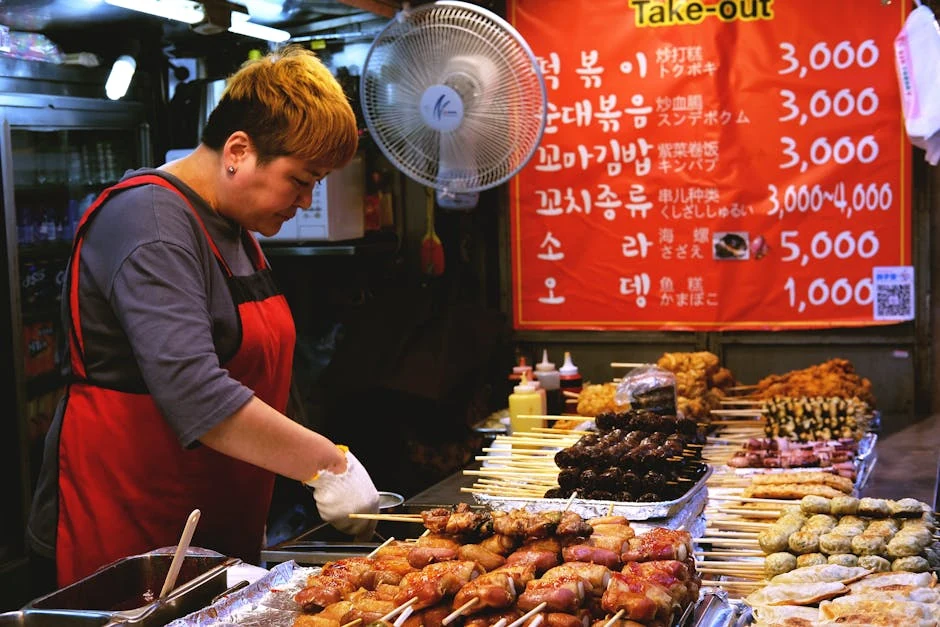
What it is: Thick, chewy cylinders of rice cake simmered in a sweet-spicy gochujang sauce. Often served with fish cakes, boiled eggs, and sometimes ramen noodles mixed in. It's the undisputed king of Korean street food.
What to expect: The texture is unlike anything in Western cuisine — imagine a dense, stretchy gnocchi soaked in a sauce that's simultaneously sweet, spicy, and deeply savory. The heat level ranges from mild to devastating depending on the vendor. If it's your first time, just point and say \"deol maepge\" (덜 맵게) — less spicy, please.
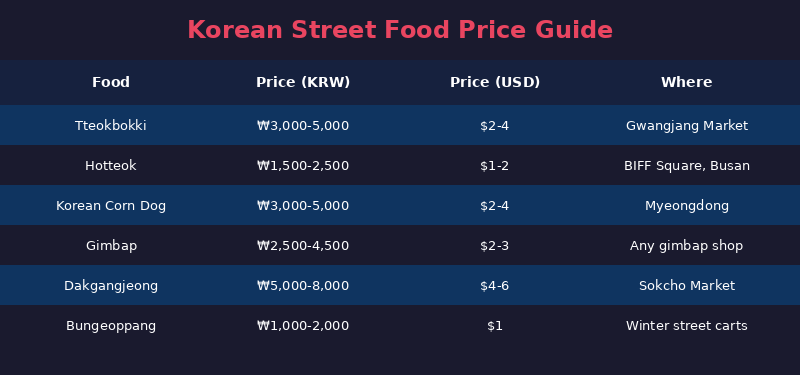
Price: ₩3,000–₩5,000 (~$2–$4 USD) for a generous cup or plate.
Where to find it:
- Gwangjang Market, Seoul — The most famous traditional market in Korea. Multiple tteokbokki stalls along the main corridor, all good.
- Sindang-dong Tteokbokki Town, Seoul — An entire alley dedicated to tteokbokki restaurants near Sindang Station (Line 2/6). This is where Seoulites go for the real deal.
- BIFF Square, Busan — The street food epicenter of Busan, right outside the Busan International Film Festival plaza. Vendors compete fiercely, which means quality stays high.
2. Hotteok (호떡) — Sweet Stuffed Pancakes
What it is: A yeasted dough ball filled with a mixture of brown sugar, cinnamon, and crushed peanuts or seeds, pressed flat on a griddle until the outside is golden-crispy and the inside turns into molten caramel. It is outrageously good.
What to expect: You'll be handed a paper cup or wrapper with a disc of crispy dough. Let it cool for at least 30 seconds — the sugar filling inside is volcanic and will burn the roof of your mouth. Everyone learns this lesson exactly once.
Price: ₩1,500–₩2,500 (~$1–$2 USD).
Where to find it:
- BIFF Square, Busan — The famous \"seed hotteok\" stalls here use a special mix with sunflower seeds, pumpkin seeds, and nuts. There's always a line. It's always worth it.
- Insadong, Seoul — The main pedestrian street has several hotteok vendors, especially good on cold days.
- Namdaemun Market, Seoul — Find the stalls near Gate 6. Locals know. Follow the smoke.
3. Bungeoppang (붕어빵) — Fish-Shaped Pastry
What it is: A fish-shaped waffle filled with sweet red bean paste (pat, 팥). The \"fish\" is purely decorative — no actual fish is involved. This is Korea's quintessential winter street food, and you'll see the distinctive fish-shaped molds on carts from November through March.
What to expect: A warm, slightly crispy exterior with sweet, earthy red bean filling. Some vendors now offer custard cream or Nutella filling for the adventurous. The red bean original remains the best.
Price: ₩1,000–₩2,000 for 2–3 pieces (~$0.70–$1.50 USD).
Where to find it:
- Everywhere in winter. Seriously — bungeoppang carts pop up on random street corners across Seoul from late November. Myeongdong, Hongdae, and any major subway exit will have at least one vendor.
- Tongin Market, Seoul — Near Gyeongbokgung Palace, this market has a famous lunch-box program and plenty of bungeoppang stalls.
4. Gimbap (김밥) — Korean Rice Rolls
What it is: Seaweed-wrapped rice rolls filled with pickled radish, spinach, egg, carrot, and your choice of protein — usually ham, tuna, beef bulgogi, or cheese. Think of it as Korea's answer to the sandwich: portable, cheap, and available literally everywhere.
What to expect: Unlike Japanese sushi rolls, gimbap rice is seasoned with sesame oil rather than vinegar, giving it a nuttier, more savory flavor. A single roll is sliced into 8–10 bite-sized pieces and served on a plate or in foil for takeaway.
Price: ₩2,500–₩4,500 per roll (~$2–$3 USD).
Where to find it:
- Any gimbap cheonguk (김밥천국). This chain name literally means \"gimbap heaven,\" and these no-frills restaurants are on almost every block in Seoul. Open early, close late, cash or card accepted.
- Gwangjang Market, Seoul — For a market-fresh version with thicker fillings. Don't miss Mayak Gimbap (마약김밥) — tiny, addictive sesame-oil-drenched rolls that Gwangjang Market is famous for. "Mayak" literally means "drug" because they're that addictive.
- Convenience stores — CU, GS25, and 7-Eleven all sell triangle kimbap (삼각김밥) for ₩1,000–₩1,500. It's the ultimate grab-and-go breakfast. Read our Korea essentials guide for more convenience store tips.
5. Tornado Potato (회오리감자) — Spiral Potato on a Stick
What it is: A whole potato spiraled onto a wooden skewer, deep-fried until golden, and dusted with your choice of seasoning — cheese, onion, honey butter, barbecue, or just plain salt. It looks like something from a food festival, and it tastes exactly as satisfying as it looks.
What to expect: Crispy, salty, starchy perfection. The spiral shape means maximum surface area for crunch. It's best eaten hot, straight from the fryer.
Price: ₩3,000–₩4,000 (~$2–$3 USD).
Where to find it:
- Myeongdong, Seoul — The main shopping street has at least five tornado potato vendors. You can't miss them.
- Haeundae Beach, Busan — Beach snack vendors along the boardwalk always carry them.
- Everland & Lotte World — Every Korean theme park has tornado potato stalls, though expect ₩5,000+ at park prices.
6. Gyeran-ppang (계란빵) — Egg Bread
What it is: A fluffy, slightly sweet bread roll with a whole egg baked right into the top. The bread is cake-like, the egg yolk is just barely set, and the combination of savory and sweet is oddly addictive.
What to expect: These come piping hot from specialized oval molds. The bottom is cakey and sweet, the top has a whole cracked egg with a soft, runny-ish yolk. Some vendors add cheese or ham. The original is best.
Price: ₩1,500–₩2,500 (~$1–$2 USD).
Where to find it:
- Hongdae, Seoul — Around the pedestrian shopping area and near Exit 9 of Hongdae Station, cart vendors sell these all day.
- Dongdaemun, Seoul — Night market stalls near Dongdaemun Design Plaza (DDP) are prime egg bread territory.
- Near university campuses — Ewha, Yonsei, and Konkuk University areas all have egg bread carts targeting hungry students.
7. Dakgangjeong (닭강정) — Sweet Crispy Fried Chicken
What it is: Bite-sized pieces of fried chicken coated in a sticky sweet-spicy glaze, often topped with peanuts or dried chili. If Korean BBQ is Korea's sit-down meat obsession, dakgangjeong is the street food equivalent.
What to expect: Intensely crunchy on the outside, juicy on the inside, and coated in a glaze that walks the line between honey and gochugaru heat. You'll get a generous paper tray full, and you will finish every piece.
Price: ₩5,000–₩8,000 for a small tray (~$4–$6 USD). Larger portions can run up to ₩15,000.
Where to find it:
- Sokcho Jungang Market — If you're visiting Seoraksan National Park, this market is famous nationally for its dakgangjeong. The queues say everything.
- Gwangjang Market, Seoul — Several stalls serve it alongside other fried snacks.
- Jagalchi Market, Busan — The upper floors have fried chicken vendors that rival the best in the country.
8. Sundae (순대) — Korean Blood Sausage
What it is: Before you run away — hear me out. Sundae (pronounced \"soon-deh,\" not like the ice cream) is steamed pig intestine stuffed with glass noodles, rice, pork blood, and vegetables. It's sliced into rounds and served with a salt-and-pepper dip.
What to expect: If you can get past the description, the taste is genuinely mild and savory. The texture is soft, almost like a stuffing. Most first-timers are surprised at how much they enjoy it. The salt-pepper dip (and sometimes a tteokbokki sauce dip) makes it.
Price: ₩3,000–₩5,000 per plate (~$2–$4 USD).
Where to find it:
- Gwangjang Market, Seoul — Arguably the best sundae in Seoul. Look for the long counter-seating stalls with ajummas slicing it fresh.
- Sundae Town, Sillim-dong, Seoul — An entire neighborhood near Sillim Station (Line 2) dedicated to sundae restaurants. This is the real local spot that tourists rarely find.
- Seomyeon, Busan — The Seomyeon food alley has several sundae restaurants serving it alongside tteokbokki in combo plates.
9. Mandu (만두) — Korean Dumplings
What it is: Korean dumplings filled with pork, kimchi, tofu, and glass noodles, then either steamed (jjin-mandu, 찐만두), pan-fried (gun-mandu, 군만두), or deep-fried. Street food mandu tend to be larger and more rustic than restaurant versions.
What to expect: Thick, doughy wrappers encasing a savory, slightly garlicky filling. The steamed version is pillowy and light. The fried version has a shattering crispy shell. Get both. Dip them in soy sauce with a touch of vinegar.
Price: ₩3,000–₩5,000 for 4–6 pieces (~$2–$4 USD).
Where to find it:
- Gwangjang Market, Seoul — Yes, again. This market is basically street food Valhalla. The mandu here are enormous and handmade.
- Namdaemun Market, Seoul — The food alley near the center of the market has great steamed mandu stalls, particularly the kalguksu-and-mandu combo shops.
- Myeongdong, Seoul — Several mandu-jip (dumpling houses) along the main street and side alleys serve them as both sit-down and takeaway.
10. Korean Corn Dogs (핫도그) — Cheese and Sausage on a Stick
What it is: Korean corn dogs have absolutely ascended past their American namesake. The concept: a sausage, mozzarella cheese stick, or combination of both, coated in batter, rolled in extras (panko, french fry pieces, ramen crumbles, rice puffs), deep-fried, and finished with sugar, ketchup, and mustard.
What to expect: The cheese versions produce the dramatic mozzarella pull that's taken over social media. The half-sausage-half-cheese version is the crowd favorite. Yes, they dust sugar on a corn dog. Yes, it works. Don't question it — just trust the process.
Price: ₩3,000–₩5,000 (~$2–$4 USD).
Where to find it:
- Myeongdong, Seoul — Multiple corn dog shops compete for the title of most Instagrammable. Chungmu Hotdog and Myeongrang Hotdog are both popular chains.
- Hongdae, Seoul — Corn dog vendors are scattered throughout the main pedestrian area. Friday and Saturday nights are peak corn dog hours.
- Any subway exit in Seoul — Honestly, Korean corn dog chains have multiplied rapidly. You're never more than a 10-minute walk from one.
Pro Tips for Eating Korean Street Food
- Carry cash for markets. While Korea is largely cashless, some traditional market vendors — especially the older ajummas — still prefer cash. Have ₩10,000–₩20,000 in small bills. See our cash vs. card guide for more detail.
- Don't be shy about pointing. If there's no English menu (there usually isn't at market stalls), just point at what looks good. Vendors are used to foreign customers and will help you.
- Go hungry. A serious market run through Gwangjang or Namdaemun will involve 5–8 different stalls. Pace yourself, but commit to trying everything.
- Winter is peak street food season. The best items — hotteok, bungeoppang, sundae — are cold-weather foods. A December or January trip is street food paradise.
- Eat where the locals eat. If a stall has a line of Korean office workers at lunch, that's the one. If it only has tourists, keep walking.
- Consider a guided tour for your first market run. Seoul market food tours on Klook take the guesswork out of ordering and cover more ground than self-guided exploration in the same time.
Restaurant & Cafe Directories
Browse our complete directories with Naver Map links for real photos, menus, and current prices:
Street Food Directories
Browse our complete directories with Naver Map links for real photos, menus, and current prices:
Frequently Asked Questions
Is Korean street food safe for tourists?
Yes. Korea has strict food safety standards, and even small market vendors are regularly inspected. I've eaten street food hundreds of times across the country and have never gotten sick. Use common sense — if something looks like it's been sitting out for hours, skip it — but generally, Korean street food is very safe.
Are there vegetarian or vegan Korean street food options?
Some, but it takes effort. Hotteok, bungeoppang, tornado potato, and vegetable mandu are often vegetarian. Tteokbokki almost always contains fish cake, and the sauce base is nearly universally made with anchovy or dried fish stock — even if no visible fish cake is present. It is not vegetarian-safe at standard street stalls. Sundae and dakgangjeong are obviously meat-based. Ask \"gogi eopseo?\" (고기 없어요?) — \"no meat?\" — and vendors will usually point you in the right direction.
What's the best street food market in Seoul?
Gwangjang Market is the most comprehensive and the most famous for a reason — it has the widest variety and the longest history. For a more local, less touristy experience, try Mangwon Market near Hapjeong Station or Tongin Market near Gyeongbokgung.
How much should I know about food allergies in Korea?
Korea uses sesame, shellfish, peanuts, tree nuts, wheat, and soy extensively. Hotteok and dakgangjeong often contain peanuts or mixed nuts. Tteokbokki sauce frequently contains shellfish-derived stock. If you have severe allergies, carry a Korean allergy card (available as printable PDFs online) that lists your allergies in Korean — show it to vendors before ordering. The phrase "알레르기가 있어요" (allereugi-ga isseoyo — "I have an allergy") is essential to know.
How much money should I budget for a street food tour?
You can eat incredibly well for ₩15,000–₩25,000 (~$11–$18 USD) per person, sampling 5–7 different items. If you go overboard (and you should at least once), budget ₩30,000–₩40,000.
Can I find Korean street food late at night?
Absolutely. Pojangmacha (포장마차) — orange tent stalls — set up in the evenings in areas like Jongno, Euljiro, and Namdaemun. Many operate until 2:00 AM or later. Important note: pojangmacha are primarily drinking spots. While you can order food without alcohol, it's customary to order at least a bottle of soju or beer with your food. Think of them as outdoor bars with excellent snacks, not just food stalls. For a guided evening experience, Seoul night food tours on Klook include pojangmacha stops with a local guide.
Myeongdong and Hongdae also have street food vendors well past midnight on weekends.
Absolutely. Pojangmacha (포장마차) — orange tent stalls — set up in the evenings in areas like Jongno, Euljiro, and Namdaemun. Many operate until 2:00 AM or later. Myeongdong and Hongdae also have street food vendors well past midnight on weekends.
Ready to eat your way across Korea? Start planning your trip with our guide to getting from Seoul to Busan — because Busan's street food scene rivals Seoul's, and you owe it to yourself to compare. Your stomach will thank you.