Best Day Trips from Seoul: 7 Easy Escapes (2026)
Seoul is electric — but after a few days of navigating Gangnam crowds and Hongdae nightlife, even the most devoted city lover craves fresh air and a change of pace. The good news? Some of South Korea's most stunning landscapes, fascinating history, and quietest villages sit less than two hours from the capital.
I've taken every one of these day trips from Seoul multiple times, and each one offers something completely different — from the surreal tension of the DMZ to the Instagram-perfect tree-lined paths of Nami Island. Here are 7 easy escapes that are totally doable in a single day, with exact transport details, costs, and timing so you can plan with confidence.
Before you head out, make sure you've got your Seoul subway system figured out — most of these trips start at a major subway station.
1. Nami Island (남이섬) — The Romantic Classic
Why Go
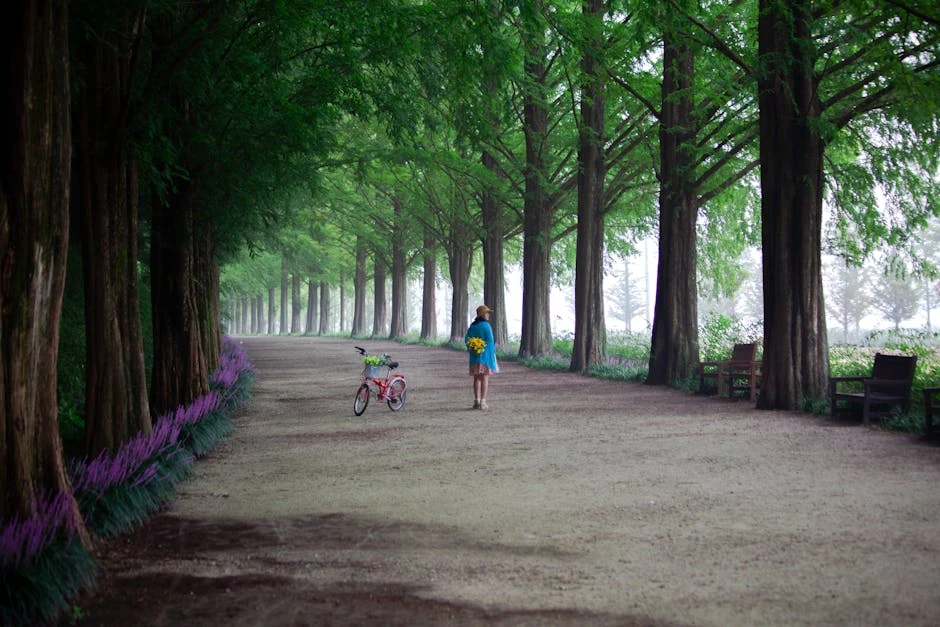
Nami Island became famous as the filming location for the K-drama Winter Sonata, and it's been a pilgrimage site for Korean drama fans ever since. But you don't need to know the show to appreciate the place. This crescent-shaped island in the middle of the Bukhan River is lined with towering metasequoia trees, chestnuts, and ginkgos that create stunning canopy tunnels in every season. Spring brings cherry blossoms, summer is lush and green, autumn explodes in orange and gold, and winter drapes the island in snow.
The island operates as its own tiny "republic" — the Naminara Republic — complete with its own stamps, currency, and customs gate. It's a bit kitschy, but honestly it adds to the charm.
If you want to keep going on the same rail line after Nami, our Chuncheon travel guide shows how to turn the trip into a full lakeside food day with dakgalbi, makguksu, and the rail bike.
How to Get There
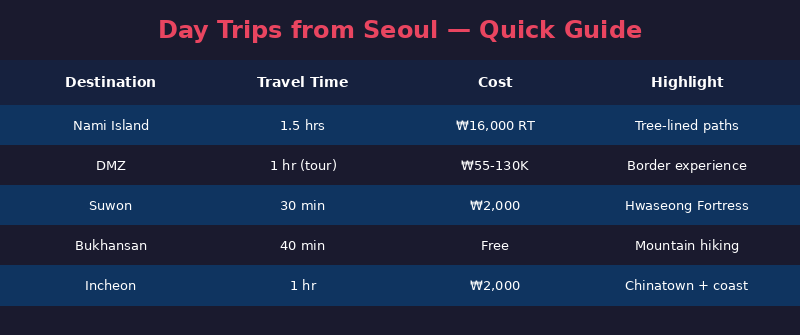
Take the ITX-Cheongchun train from Yongsan Station or Cheongnyangni Station to Gapyeong Station. The ride takes about 1 hour 20 minutes and costs around ₩6,900 (~$5 USD). From Gapyeong Station, hop on the local shuttle bus (10 minutes, ₩1,500) or grab a taxi for about ₩5,000 to the Nami Island ferry wharf. The ferry crossing takes 5 minutes.
Entrance + ferry combo ticket: ₩16,000 (~$12 USD) for adults.
Time Needed
Half a day minimum, but budget a full day if you want to combine it with the nearby Garden of Morning Calm (especially during their seasonal light festivals). Most people spend 3-4 hours on the island itself.
What to See
- Metasequoia Lane — the iconic tree-lined road, absolutely unmissable for photos
- Central Korean Pine Lane — quieter and equally beautiful
- UNICEF Train — a small train that loops the island (₩5,000)
- Song Museum — dedicated to the island's cultural quirks and art installations
- Rent a tandem bike (₩10,000/hour) to cover the whole island at a relaxed pace
🎟️ Book Nami Island
2. The DMZ (Demilitarized Zone) — History That Gives You Chills
Why Go
There's nowhere else on Earth quite like the DMZ. The 4-kilometre-wide buffer zone between North and South Korea is simultaneously one of the most heavily militarized borders on the planet and an accidental nature preserve. Standing at the JSA (Joint Security Area) where soldiers from both sides face each other across a concrete slab — that's a moment that stays with you.
How to Get There
You cannot visit the DMZ independently — you must book an organized tour. Several operators run daily departures from central Seoul. Tours cost between ₩55,000 and ₩85,000 (~$40-65 USD) depending on which areas are included (JSA tours are pricier but worth it). Most tours pick up near Gwanghwamun or Myeongdong between 7:00 and 8:00 AM.
Book at least 3-5 days in advance, especially for JSA tours. You'll need your passport — they check it multiple times. There's a dress code too: no flip-flops, no sleeveless tops, no ripped jeans. The military takes this seriously.
Time Needed
A full day. Most tours run from around 8:00 AM to 3:00-4:00 PM. Half-day tours exist but they skip the JSA, which is arguably the most impactful part.
What to See
- Joint Security Area (JSA) — step inside the blue UN buildings that straddle the border (you'll technically be in North Korea for a moment)
- Dora Observatory — peer into North Korea through binoculars
- Third Infiltration Tunnel — walk 73 metres underground into a tunnel North Korea dug for a potential invasion
- Dorasan Station — the last train station before North Korea, hauntingly empty
- Imjingak Peace Park — memorials, the Bridge of Freedom, and thousands of ribbons carrying wishes for reunification
If you're visiting South Korea for the first time, I'd put this at the top of your list. Read up on essential things to know before visiting Korea so the cultural and historical context hits harder.
🎟️ Book a DMZ Tour
3. Suwon Hwaseong Fortress (수원화성) — A UNESCO World Heritage Gem
Why Go
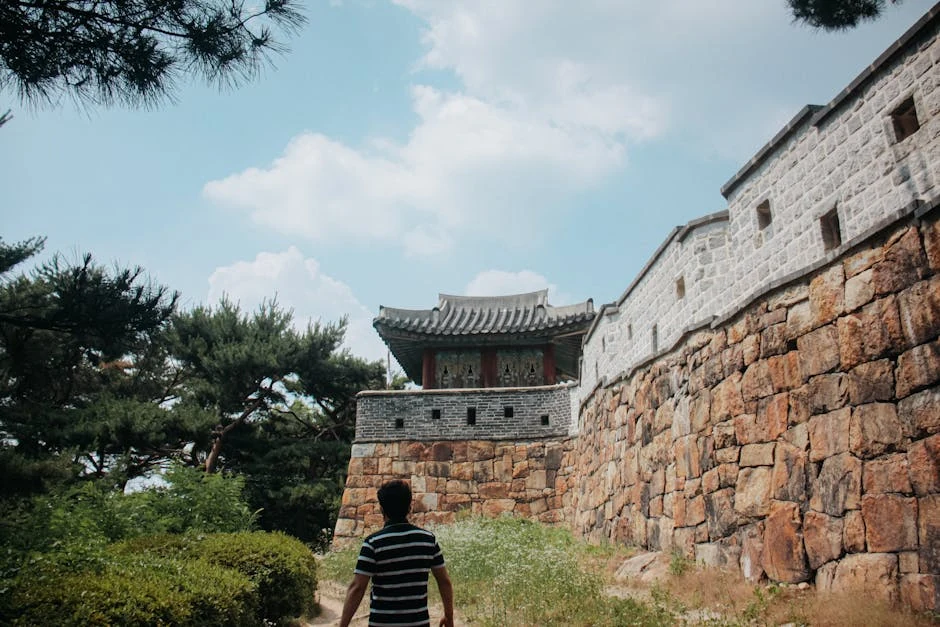
Suwon is technically a separate city, but it's so close to Seoul that it barely feels like leaving. The star attraction is Hwaseong Fortress, a massive 18th-century walled fortification that stretches 5.7 kilometres around the old city centre. Built by King Jeongjo in 1796 to honour his father, it's one of the best-preserved examples of Korean military architecture and a UNESCO World Heritage Site since 1997.
How to Get There
This is ridiculously easy. Take Seoul Metro Line 1 (Blue) from Seoul Station to Suwon Station. It takes about 60 minutes and costs ₩1,750 (~$1.30 USD) with a T-money card. From Suwon Station, it's a 15-minute bus ride (bus 11, 13, or 36) or a ₩5,000 taxi to Paldalmun Gate, the main southern entrance.
Time Needed
4-6 hours to walk the full fortress wall and explore the surrounding area. Add another hour or two for the traditional market.
What to See
- Full wall walk — the complete 5.7km circuit takes about 2 hours at a leisurely pace, passing through four main gates and dozens of guard towers
- Hwaseong Haenggung Palace — the temporary palace inside the walls (₩1,500 entry)
- Korean archery experience — try traditional archery at the Yeonmudae training ground (₩2,000 for 10 arrows)
- Suwon Tongdak Street — the fortress area is famous for Korean fried chicken. Yongseong Tongdak is the legendary original shop
- Suwon Traditional Market (Paldalmun Market) — one of the oldest and largest traditional markets in Korea
The fortress wall itself is free to walk. Individual attractions inside have small entry fees ranging from ₩1,000-3,000.
🎟️ Book Suwon Tours
🎡 Bonus: Everland — Korea's Largest Theme Park
If a theme park day sounds more your speed, Everland in Yongin (~40 min from Gangnam by shuttle) is South Korea's biggest theme park — home to the T-Express wooden coaster, a safari zone, and year-round seasonal festivals. See our full Everland guide for transport details, ticket tips, and what's worth your time.
4. Bukhansan National Park (북한산) — A Proper Mountain Hike
Why Go
You don't even need to leave Seoul's city limits for this one. Bukhansan National Park sits on Seoul's northern boundary, and its granite peaks and forested valleys make it feel like you've teleported to the wilderness. With 836-metre Baegundae Peak as the centrepiece, it's one of the most visited national parks in the world — but the trails are well-maintained and there's enough variety for everyone from casual walkers to serious scramblers.
How to Get There
The most popular starting point is Bukhansan National Park entrance near Gupabal Station (Line 3). From Exit 1, take bus 704 or 34 to the park entrance (10 minutes). Alternatively, start from Ui Station (Line 4/Ui LRT) for the Ui-dong valley trails. The park is free to enter.
Check your Seoul subway guide for the best route from wherever you're staying.
Time Needed
3-6 hours depending on your route. The Baegundae Peak summit trail from Bukhansan Shelters takes about 2-3 hours up and 1.5-2 hours down. Easier options like the Bukhansanseong Trail (fortress wall route) take 2-3 hours total.
What to See
- Baegundae Peak — the highest point with jaw-dropping panoramic views of Seoul's skyline (moderate-difficult trail, involves some rock scrambling with steel cable sections)
- Bukhansanseong Fortress — ancient fortress walls running along the ridgeline
- Wonhyo Peak — slightly easier alternative to Baegundae with equally stunning views
- Buddhist temples — several small temples tucked into the valleys, including Jingwan Temple
- Post-hike pajeon — the restaurants at the trailhead serve Korean pancakes (파전) and makgeolli (rice wine), a beloved Korean hiking tradition
Important: Trails close during heavy rain and some sections require advance reservation during peak season (spring/autumn weekends). Check the Korea National Park Service website before you go.
5. Incheon Chinatown & Wolmido (인천 차이나타운)
Why Go
Incheon is technically Korea's third-largest city, but it's so close to Seoul that most tourists breeze through on their way from the airport without stopping. That's a mistake. Incheon's Chinatown — Korea's only official Chinatown — has a character completely unlike anything in Seoul, and the nearby Wolmido island boardwalk is a fun, retro seaside escape.
How to Get There
Take Seoul Metro Line 1 (Blue) from Seoul Station to Incheon Station (the last stop, not Incheon Airport). The ride takes about 70 minutes and costs ₩2,050 (~$1.50 USD). Chinatown starts literally across the street from the station exit. You can also take the faster AREX express to Incheon and transfer to Line 1, which cuts about 15 minutes off the journey.
Time Needed
4-5 hours to cover Chinatown and Wolmido. Add extra time if you want to explore Songwol-dong Fairy Tale Village or the Open Port area.
What to See
- Jajangmyeon Street — jajangmyeon (black bean noodles) was invented here by Chinese-Korean immigrants. Try it at Gonghwachun or any of the original restaurants. A bowl costs ₩7,000-9,000 (~$5-7 USD)
- Songwol-dong Fairy Tale Village — a hillside neighbourhood transformed into a walkable storybook with murals from classic fairy tales
- Jayu Park — Korea's first Western-style park, with great harbour views and a statue of General MacArthur
- Wolmido Island — take the Wolmi Sea Train (monorail, ₩8,000) along the coast, then walk the boardwalk for raw fish restaurants and amusement park rides
- Chinese-Korean street food — kkochi-tanghulu (candied fruit skewers) and giant mandu (dumplings) for ₩3,000-5,000
🎟️ Book Incheon Tours
6. Ganghwa Island (강화도) — Off the Tourist Trail
Why Go
If you want to go somewhere that 95% of foreign tourists don't know about, Ganghwa Island is your answer. This large island off the west coast has been strategically important for centuries — it served as the Korean government's refuge during Mongol invasions and was the site of clashes with French and American forces in the 1800s. Today it's a quiet, rural escape with dolmen sites (prehistoric stone tombs), centuries-old temples, and coastal mudflat trails.
How to Get There
Take bus 3000 from Sinchon Station (Line 2) directly to Ganghwa Bus Terminal. The ride takes about 90 minutes and costs ₩3,000 (~$2.20 USD). Alternatively, take the subway to Gimpo Airport Station and then bus 3000 from there (about 70 minutes). Once on the island, local buses connect the main sites, but having a rented car or using taxis (affordable on the island) makes things much easier.
Time Needed
A full day. There's a lot of ground to cover, and the island is larger than most people expect. Starting early is key.
What to See
- Ganghwa Dolmen — UNESCO World Heritage prehistoric burial sites dating back to the Bronze Age (free)
- Jeondeungsa Temple — one of Korea's oldest temples, founded in 381 AD, set within the walls of an ancient fortress (₩3,000 entry)
- Ganghwa Peace Observatory — on a clear day you can see into North Korea across the estuary (₩2,500)
- Bomunsa Temple — a cliff-side temple on nearby Seongmo Island, reached by a short ferry (temple entry ₩2,000, ferry ₩4,000 round trip)
- Ganghwa Mudflat Centre — if you visit during low tide, you can walk the mudflats and dig for clams (seasonal, spring through autumn)
- Ssanghwacha — Ganghwa is famous for mugwort, ginseng, and turnip. Try the local herbal teas and rice cakes at the traditional market
7. Pocheon Art Valley (포천아트밸리) — Quarry Turned Masterpiece
Why Go
This is one of Korea's most unusual attractions — an abandoned granite quarry that's been transformed into a cultural park and art space. The centrepiece is a stunning turquoise lake that formed naturally in the quarry pit, surrounded by sheer rock walls that look almost alien. The colour of the water (from dissolved minerals) is genuinely surreal, and it changes with the seasons and weather.
How to Get There
This is the trickiest day trip on the list in terms of transport. Take Subway Line 1 to Uijeongbu Station, then transfer to bus 138-6 (about 50 minutes to Sinbuk-myeon). From there you'll need a taxi (~₩8,000) to Art Valley. Total travel time is about 2-2.5 hours each way. Alternatively, book a shuttle tour from Seoul for ₩30,000-50,000 that includes Pocheon Art Valley and sometimes Herb Island as a combo trip.
Entrance fee: ₩5,000 adults (~$3.70 USD). The monorail to the top viewing platform costs an additional ₩4,500 round trip (highly recommended — it saves you a steep uphill walk).
Time Needed
2-3 hours at Art Valley itself, but factor in 4-5 hours of travel round trip. I'd combine it with nearby Herb Island or Pocheon Ideok Valley to make the journey worthwhile.
What to See
- Cheonjuho Lake — the main turquoise quarry lake (20 metres deep, no swimming obviously) — the viewing platform above it is spectacular
- Sculpture park — outdoor art installations scattered along the walking paths
- Astronomy Science Centre — a small planetarium and observatory included in your ticket
- Monorail ride — the short monorail up the quarry wall gives you aerial views of the lake and surrounding mountains
- Seasonal events — light festivals in winter, concerts in summer at the amphitheatre built into the quarry
If you're short on time and want to pick between day trips, consider heading to Busan instead via KTX — it's technically doable as a day trip if you leave early enough, though I'd recommend at least one overnight.
Day Trip Planning Tips
Get a T-money Card
If you don't already have one, get a T-money card from any convenience store (₩2,500 for the card, then load it up). It works on all Seoul subways, buses, and most intercity buses. It also gets you transfer discounts. Check our complete Seoul subway guide for more details.
Leave Early
Every single one of these trips is better when you start early. The 8:00 AM train to Gapyeong means you hit Nami Island before the tour bus crowds arrive around 11:00 AM. The DMZ tours that depart at 7:30 AM get you to the JSA before the midday rush.
Pack a Charger and Snacks
Korean trains and buses are comfortable but don't always have charging ports. A portable battery and a few snacks from the nearest CU or GS25 convenience store will keep you going. Most day trip destinations also have restaurants and convenience stores, but Ganghwa Island and Pocheon are more rural — don't assume food will be right at the trailhead.
Weekdays Beat Weekends
Koreans love their weekend outings, and places like Bukhansan and Nami Island can get genuinely crowded on Saturdays and Sundays, especially during cherry blossom and autumn foliage seasons. If you have any flexibility in your schedule, go on a weekday.
Check Weather and Seasonal Closures
Bukhansan trails close during heavy rain. Nami Island is gorgeous year-round but peak foliage (late October/early November) and cherry blossom season (late March/early April) are magical. The DMZ can close without notice due to military activities. Always check the morning of your trip.
Day Trip Restaurant Directories
Browse our complete directories with Naver Map links for real photos, menus, and current prices:
Frequently Asked Questions
What is the best day trip from Seoul for first-time visitors?
The DMZ is the most unique and impactful day trip you can take from Seoul. There's simply nothing like it anywhere else in the world. If you've already done that (or prefer nature over history), Nami Island combined with the Garden of Morning Calm is a crowd-pleaser for good reason.
Can I do day trips from Seoul without speaking Korean?
Absolutely. All major subway and train stations have English signage, and destinations like Nami Island, the DMZ, and Suwon Hwaseong are very tourist-friendly with English maps and signs. For more rural spots like Ganghwa Island, having a translation app helps, but you'll manage fine with gestures and Google Translate. Check our things to know before visiting Korea guide for more language tips.
How much should I budget for a day trip from Seoul?
Most self-guided day trips cost between ₩20,000 and ₩40,000 (~$15-30 USD) including transport, entry fees, and lunch. The DMZ is the most expensive at ₩55,000-85,000 because you need a guided tour. Bukhansan is the cheapest — the park is free and the subway ride costs under ₩2,000.
Is the T-money card accepted for all these day trips?
T-money works on all Seoul subways and city buses, the Line 1 trains to Suwon and Incheon, and most intercity buses. For the ITX train to Gapyeong (Nami Island), you'll need to buy a separate ticket at the station or through the Korail app. DMZ tours are booked and paid separately.
What is the best season for day trips from Seoul?
Spring (April-May) and autumn (October-November) are the sweet spots — comfortable temperatures, manageable humidity, and stunning scenery. Summer (June-August) is hot and humid with monsoon rains in July. Winter (December-February) is cold but beautiful, especially at Nami Island under snow. Each season changes the character of these trips dramatically.
Can I visit Busan as a day trip from Seoul?
Technically yes — the KTX takes only 2.5 hours each way. But I wouldn't recommend it unless you're really pressed for time. Busan deserves at least an overnight stay. Check our Seoul to Busan guide for the full breakdown of transport options and what to see.