Seoul to Busan 2026: KTX Bullet Train, Bus & Flight Times
So you've explored Seoul's neon-lit streets, stuffed yourself with street food in Myeongdong, and now you're ready for Korea's second city. The question every traveler asks: what's the best way to get from Seoul to Busan?
I've made this trip more times than I can count — by bullet train with a coffee in hand, crammed into a late-night bus after a weekend in Hongdae, and once on a budget airline where the flight was shorter than the time I spent getting to the airport. Each option has its place depending on your budget, schedule, and how much you value legroom.
Here's the honest breakdown for 2026, with updated prices, schedules, and the booking tricks that most guides leave out. Once you arrive, check our Busan travel guide and things to do in Busan for what comes next.
🏨 Plan Your Busan Stay
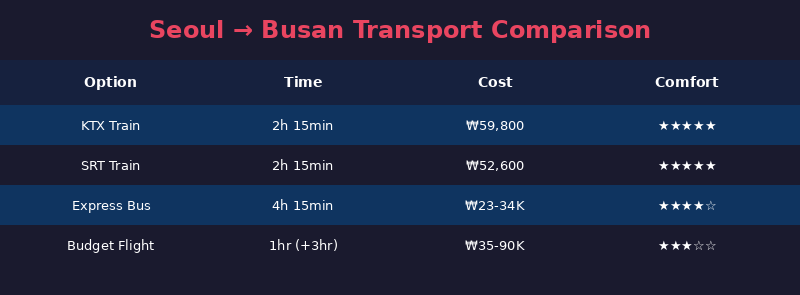
The Quick Comparison: Seoul to Busan at a Glance
| Option | Travel Time | Cost (One-Way) | Best For |
|---|---|---|---|
| KTX Bullet Train | 2 hrs 15 min – 2 hrs 40 min | ₩59,800 (~$43 USD) | Most travelers, convenience |
| SRT (Suseo) | 2 hrs 15 min – 2 hrs 30 min | ₩52,600 (~$38 USD) | Savings + south Seoul departure |
| Express Bus | 4 hrs 15 min – 4 hrs 40 min | ₩23,000–₩34,000 (~$17–$25 USD) | Budget travelers |
| Budget Flight | 1 hr (+ airport time) | ₩35,000–₩90,000 (~$25–$65 USD) | Deals or island connections |
Option 1: KTX Bullet Train — The Gold Standard
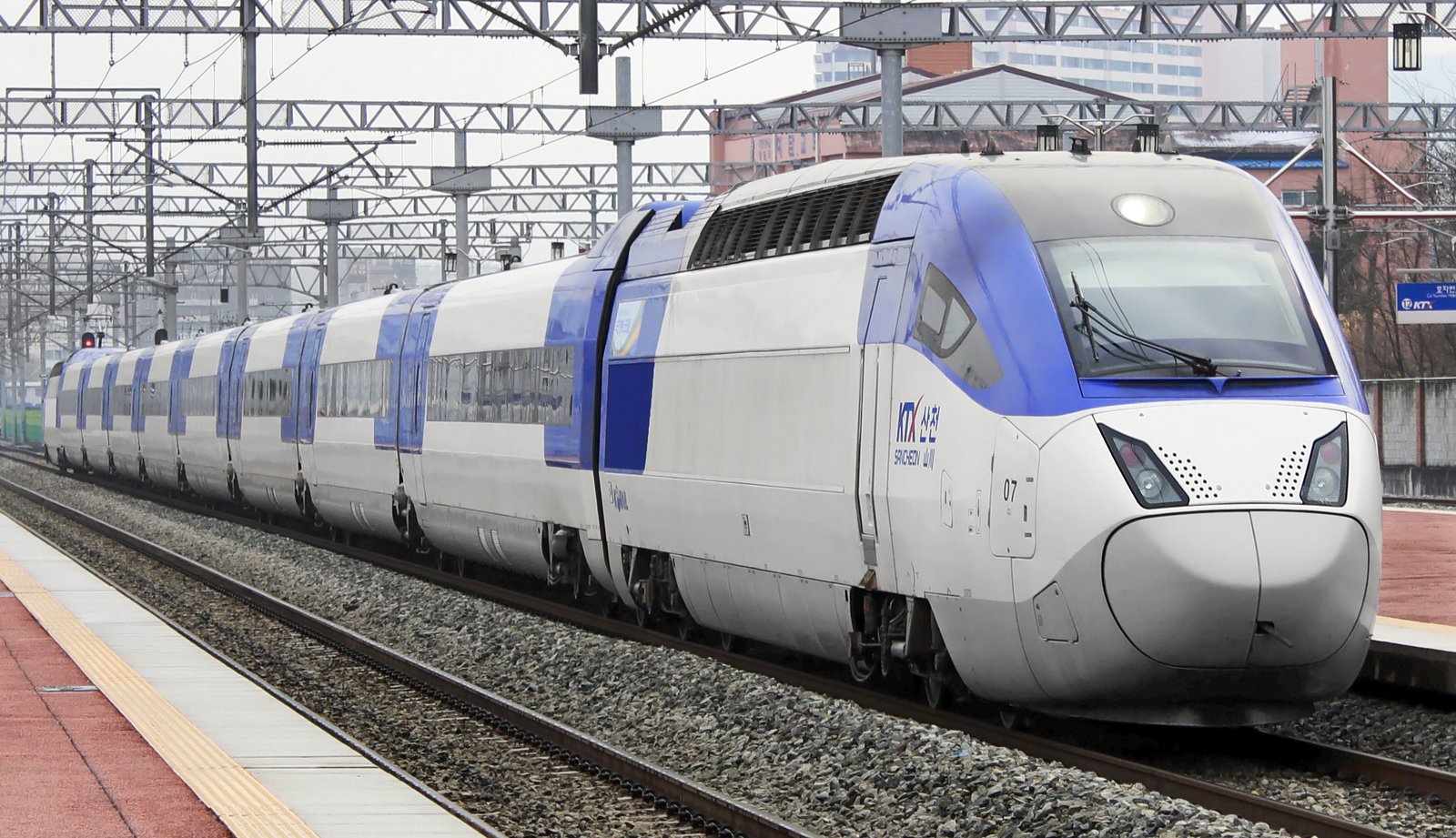
The KTX is how most people travel from Seoul to Busan, and for good reason. You walk into Seoul Station, tap your phone or ticket, sit down in a wide comfortable seat, and roughly two hours and fifteen minutes later you're standing in Busan. No security lines, no baggage restrictions, no turbulence.
KTX Basics: Speed, Schedule, and Stations
KTX trains depart from Seoul Station (서울역) in central Seoul and from Yongsan Station (용산역) about ten minutes south. Both are directly connected to Seoul's subway system — Seoul Station sits on Lines 1 and 4, while Yongsan is on Line 1. If you're staying in Itaewon or Yongsan-gu, Yongsan Station saves you a transfer.
Trains run roughly every 15 to 30 minutes during peak hours (roughly 6:00 AM to 9:00 PM), with the first departure around 5:15 AM and the last train leaving at 9:00 PM. The ride to Busan Station (부산역) in the city center takes about 2 hours 15 minutes on the nonstop service, or up to 2 hours 40 minutes if the train makes intermediate stops at Daejeon, Dongdaegu, or Ulsan.
KTX Ticket Prices in 2026
- Standard class (일반실): ₩59,800 (~$43 USD)
- First class (특실): ₩83,700 (~$61 USD)
- Standing ticket: ₩47,800 (~$35 USD) — same train, no assigned seat
First class gets you wider leather seats arranged 2+2 instead of 3+2, a bit more legroom, and a quieter car. Honestly, standard class is perfectly comfortable for a two-hour ride. Save the splurge for a nice Korean BBQ dinner in Busan instead.
How to Book KTX Tickets as a Foreigner
This is where most English guides get vague, so let me be specific:
Option A: Korail Website or App (Best Price)
- Download the Korail Talk app or visit letskorail.com
- Create an account using your passport number — yes, it works with foreign passports
- Search your route, select your train, and pay with an international credit card (Visa and Mastercard both work reliably now)
- Your ticket is stored in the app. Show the QR code to the gate scanner or the conductor
Option B: Station Ticket Window
Walk up to the international ticket counter at Seoul Station (look for signs saying \"Foreigners\" or \"International\"). Staff speak English. You can pay with card or cash. This is the fallback if the app gives you trouble, but during Chuseok or Lunar New Year holidays, the lines are brutal.
Option C: Klook or KKday (Pre-booking from overseas)
Third-party platforms let you reserve KTX tickets before you land in Korea. You'll pay a small markup (usually ₩3,000–₩5,000 extra), but you get an English confirmation email and easy cancellation. Worth it for peak travel dates.
The Korea Rail Pass (KR Pass) — Is It Worth It?
The KR Pass is a foreigners-only unlimited rail pass, similar to Japan's JR Pass. In 2026, pricing is:
- 2-day pass: ₩121,000 (~$88 USD)
- 3-day pass: ₩138,000 (~$100 USD)
- 5-day pass: ₩169,000 (~$123 USD)
A single Seoul-to-Busan round trip costs ₩119,600. So a 2-day pass pays for itself with just the round trip plus any additional short rides. If you're doing Seoul → Busan → Gyeongju → back to Seoul, the 3-day pass is a no-brainer.
Pro tip: The KR Pass must be purchased online before arriving in Korea (or within a limited window after arrival). Don't wait until you're standing at Seoul Station.
Seoul Station and Yongsan Station: What to Know
Seoul Station is a massive hub. The KTX platforms are in the newer building (connected to the Lotte Mart and Lotte Outlet in the basement — great for last-minute snacks). There are coin lockers on B1 level near the subway connection, ranging from ₩2,000 to ₩5,000 depending on size. Arrive at least 20 minutes early if it's your first time navigating the station.
Yongsan Station is smaller and less hectic. It's attached to a large shopping complex (formerly the electronics market, now mixed retail). Fewer trains depart from here for the Seoul-Busan route, but if you're nearby, check the schedule — it's a much calmer experience.
Option 2: SRT from Suseo Station — The Locals' Secret
The SRT (Super Rapid Train) is Korea's second high-speed rail operator. It runs from Suseo Station (수서역) in southern Seoul to Busan, and it's consistently cheaper than KTX — about ₩52,600 for a standard seat.
Suseo Station is on Subway Line 3 and the Bundang Line, making it convenient if you're staying in Gangnam, Jamsil, or anywhere in south Seoul. The trains are newer, the station is less crowded than Seoul Station, and the travel time is virtually identical.
Book through the SRT app (available in English) or at srail.or.kr. The SRT is not covered by the KR Pass — that only works on Korail services.
Option 3: Express Bus — The Budget Play
Korea's intercity bus network is outstanding and criminally underrated by foreign tourists. Buses from Seoul to Busan depart from two main terminals:
- Seoul Express Bus Terminal (고속터미널) — Subway Line 3/7/9, the main hub
- Seoul Nambu Terminal (남부터미널) — Subway Line 3, sometimes has more availability
Bus Classes and Prices
- 일반 (Standard): ₩23,000 (~$17 USD) — comfortable 2+2 seating
- 우등 (Premium): ₩34,000 (~$25 USD) — 3-abreast seating, more legroom, reclining seats
The ride takes about 4 hours 15 minutes to 4 hours 40 minutes depending on traffic. Buses depart every 15–30 minutes throughout the day, starting from around 6:00 AM with the last departure around 12:30 AM (yes, there are late-night buses).
How to Book Bus Tickets
Use the T-money Express Bus app (고속버스 모바일) or the website kobus.co.kr. The English version works fine. You can also just walk up to the counter at the terminal — buses rarely sell out completely except during major holidays.
Premium class on a bus is genuinely comfortable. The seats recline far back, there's a USB charging port, and you get a footrest. For solo travelers or anyone watching their budget, the premium bus is excellent value.
Option 4: Budget Flights — Sometimes Genius, Sometimes Pointless
Several airlines fly from Gimpo Airport (GMP) in western Seoul to Gimhae Airport (PUS) near Busan. Flight time is about 55 minutes.
Airlines and Prices
- Korean Air / Asiana: ₩60,000–₩90,000 (~$43–$65 USD)
- Jin Air / T'way / Jeju Air: ₩35,000–₩55,000 (~$25–$40 USD)
On paper, those budget fares look competitive. But here's the reality check:
Total time door-to-door: Getting to Gimpo Airport takes 40–60 minutes from central Seoul. Check-in and security add 60 minutes (domestic flights are quicker, but still). The flight is 55 minutes. Then you land at Gimhae, which is 45–60 minutes from central Busan by subway or bus. Total: roughly 3.5 to 4 hours — barely faster than the KTX, which drops you in the heart of Busan.
Flights only make sense if: (a) you find a truly cheap fare under ₩40,000, (b) you're connecting onward from Gimhae to Jeju Island, or (c) you're already near Gimpo Airport.
My Recommendation: Which Should You Pick?
For most travelers: Take the KTX or SRT. It's the perfect balance of speed, comfort, price, and convenience. You leave from the city center and arrive in the city center. No security theater, no baggage anxiety, and you get to watch the Korean countryside fly past your window.
On a tight budget: The premium express bus is excellent. You'll spend two extra hours on the road, but you'll save ₩25,000+ that you can spend on street food in Busan's BIFF Square.
For flexibility: Buses run latest into the night. If you miss the last KTX at 9 PM, there's still a midnight bus waiting for you.
For families or groups: KTX standard class. Kids under 6 ride free on your lap, and ages 6–12 get a 50% discount. The seats are spacious enough that nobody's elbowing each other for four hours.
Arriving in Busan: Quick Orientation
Busan Station (KTX/SRT) is right in the Dong-gu district, walking distance to Busan's famous Jagalchi Fish Market and connected to Subway Line 1. From here, Haeundae Beach is about 40 minutes by subway, and Gamcheon Culture Village is a short bus ride away.
Busan Central Bus Terminal (Nopo-dong) is at the far north end of Subway Line 1. It's further from the main tourist areas, so factor in 30–40 minutes of subway time to get to Seomyeon or Haeundae after you arrive.
This is one reason the KTX has an edge — Busan Station's central location saves you real time on the other end.
Booking Tips: Avoid the Rookie Mistakes
- Book early for holidays. Chuseok (September/October) and Lunar New Year (January/February) are absolute chaos. Tickets sell out weeks in advance. Set a reminder and book the moment reservations open (usually one month before departure).
- Tuesday and Wednesday are cheapest. Weekend KTX trains fill up fast and have no discounts. Midweek travel sometimes offers early-bird pricing.
- Grab a window seat on the right side heading south for occasional ocean views as you approach Busan.
- Load your T-money card before traveling. You'll need it for subway connections at both ends. You can load it at any convenience store. Read our complete T-money guide for details.
- Pack snacks. KTX has a small cafe car but the selection is limited. Grab triangle kimbap and a coffee from the CU or GS25 inside Seoul Station before boarding.
Frequently Asked Questions
Can I use my T-money card on the KTX?
No. T-money works on subways, city buses, and convenience store purchases, but not on KTX or intercity express buses. You need a separate KTX ticket booked through Korail, the station window, or a third-party platform.
Is the KTX safe for solo female travelers?
Absolutely. Korea's trains are extremely safe. The KTX has CCTV throughout, well-lit cars, and staff on board. Many Korean women travel solo by KTX daily — it's just normal commuting for some people.
Can I bring luggage on the KTX?
Yes. There are overhead racks and luggage storage areas at the end of each car. There's no strict weight or size limit for regular luggage, but if you're hauling oversized items (surfboard, bicycle), you may need to book a special baggage spot. Standard suitcases are totally fine.
What if I miss my KTX train?
If you miss your train, go to the ticket window immediately. For standard tickets, you can exchange for a later train (subject to availability) with a small change fee, usually a small percentage of the ticket price (typically 5-15% depending on timing). If you bought a discounted or promotional ticket, the change policy may be stricter. Standing tickets on the next available train are always an option.
Is the Seoul-Busan KTX scenic?
It's pleasant but not spectacular. You'll pass through green countryside, rice paddies, and occasional mountain tunnels. The stretch approaching Busan along the coast has some nice views. For truly scenic train rides in Korea, the coastal trains along the East Sea (Gangneung line) are better.
Planning your Seoul-to-Busan trip? Make sure you've read our guide to 15 things to know before visiting Korea so you don't make the classic first-timer mistakes. Once you arrive, our Busan travel guide has everything you need, and where to stay in Busan covers the best neighborhoods and hotels. If you're building a longer itinerary, see our 7, 10 & 14-day Korea itinerary and budget guide.