Complete Seoul Subway Guide for Foreigners (2026)
Complete Seoul Subway Guide for Foreigners (2026)
Seoul's subway system is one of the best in the world — and I don't say that lightly. It's clean, absurdly punctual, cheap, and covers virtually every corner of this massive city. But if you're standing in Seoul Station for the first time, staring at a map that looks like a bowl of rainbow-colored noodles, it can feel overwhelming.
This guide breaks down everything you need to know to ride the Seoul Metro like a local, from buying your first T-money card to catching the last train home after a night out in Hongdae.
The Basics: How Seoul's Subway System Works
Seoul's metro network has over 20 lines covering more than 700 stations across the Seoul Metropolitan Area — including Incheon and satellite cities like Suwon, Bundang, and Goyang. You'll mostly use Lines 1 through 9, the Shinbundang Line, and the AREX (Airport Railroad Express) during a typical trip.
Each line is color-coded and numbered, which makes navigation surprisingly straightforward once you understand the system. Line 1 is dark blue, Line 2 is green (and forms a massive loop through all the major city center areas), Line 3 is orange, Line 4 is light blue, and so on. Every station also has a unique three-digit number — for example, Gangnam is 222 (Line 2, station 22). This numbering system is your best friend when you don't read Korean.
Trains run from approximately 5:30 AM to midnight, with frequencies of 2-3 minutes during peak hours and 5-8 minutes during off-peak times. On weekends and holidays, the first trains run slightly later and the last trains slightly earlier, so always double-check if you're cutting it close.
Getting a T-money Card (Your Subway Lifeline)
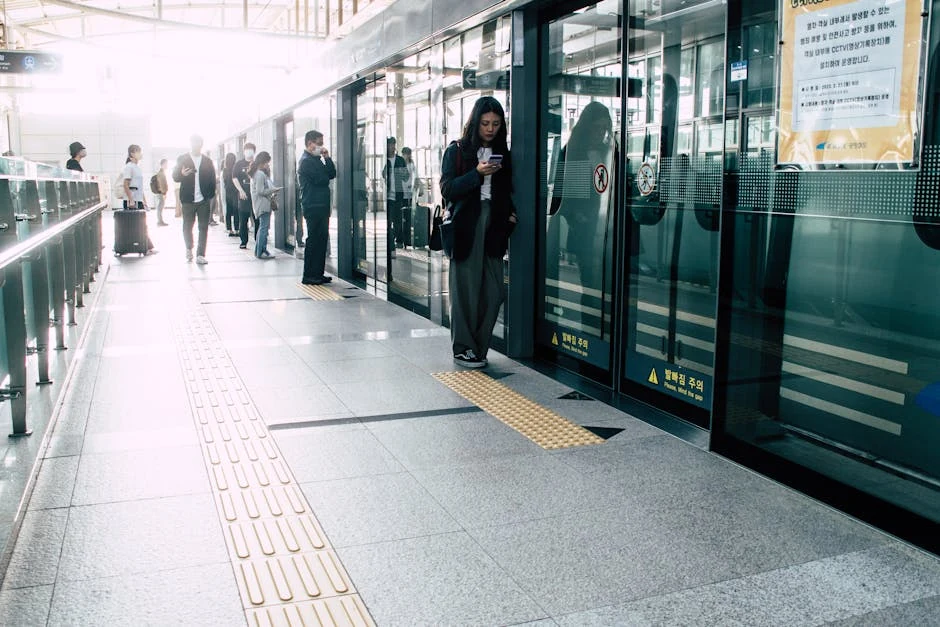
A T-money card is a rechargeable transit card that works on every subway line, every city bus, and even taxis across South Korea. You absolutely need one. Technically you can buy single-journey tokens from machines at every station, but they cost ₩100 more per ride and you'll waste time buying a new one every trip.
Where to Buy
You can grab a T-money card at any convenience store — CU, GS25, 7-Eleven, or Emart24. They're stacked right next to the register. The card itself costs ₩2,500 (about $1.80 USD). You'll also find them at ticket vending machines inside subway stations, though convenience stores are easier since the staff can help you.
There are also specialty T-money cards with K-pop idols, cartoon characters, or Seoul landmarks printed on them — same price, just more fun. The souvenir shops around Myeongdong sell limited-edition designs if you want something to take home.
How to Recharge
Load money onto your T-money card at the \"T-money Charge\" machines found in every subway station. They accept both cash and (usually) credit cards. Most convenience stores will also top up your card — just hand it to the cashier and say the amount. I recommend loading ₩20,000–₩30,000 (roughly $14–$22 USD) to start. A single subway ride costs ₩1,400 (about $1 USD) for the first 10 km, with small increments added for longer distances.
Pro tip: If you have a newer iPhone or Samsung phone, you can add a T-money card directly to your phone's mobile wallet. Apple added T-money support to Apple Pay in Korea, and Samsung Pay has had it for years. This means one less thing to carry around.
How to Read the Subway Map
Pull up the official Seoul Metro map on your phone (or grab a paper copy from the information booth at any major station). Here's how to decode it:
- Colors = Lines. Follow the color of your line from origin to destination.
- Numbers = Stations. The three-digit station code tells you the line (first digit) and position. Station 320 is Line 3, station 20.
- Circles with multiple colors = Transfer stations. Where two or more colors overlap, you can switch lines. Major transfer hubs include Seoul Station (Lines 1, 4, AREX, KTX), Jongno 3-ga (Lines 1, 3, 5), Dongdaemun History & Culture Park (Lines 2, 4, 5), and Express Bus Terminal (Lines 3, 7, 9).
- All signs are bilingual. Station names, direction indicators, exit numbers — everything is written in Korean and English. Many stations also display Chinese and Japanese.
Don't try to memorize the whole map. Instead, learn the main line you'll be riding most (probably Line 2 if you're staying in the Gangnam, Hongdae, or Myeongdong areas) and figure out your transfer points from there.
Navigating Transfers Without Losing Your Mind
Transfers in Seoul are free as long as you tap your T-money card properly — you don't need to tap out and back in. Just follow the transfer corridor signs. Some transfers are quick (a 2-minute walk) and some are genuinely long underground hikes. The transfer at Sindorim between Lines 1 and 2 is notoriously lengthy, and the connection between Lines 5 and 9 at Yeouido will have you walking for a solid 7-8 minutes.
Color-coded floor signs and overhead banners guide you through every step. Look for the line number and color of the line you want to transfer to, and follow the arrows. If the sign says \"Line 2 Outer Circle (외선)\" versus \"Inner Circle (내선),\" that refers to the direction — Line 2 runs in a loop, so clockwise and counterclockwise matter.
The Airport Line (AREX): Getting to and from Incheon
The AREX (Airport Railroad Express) connects Incheon International Airport to Seoul Station in central Seoul. There are two options:
All-Stop Train
Takes about 58 minutes from Incheon Airport Terminal 1 to Seoul Station, stopping at every station along the way. Costs just ₩4,150 with a T-money card. This is the budget option and honestly perfectly fine for most travelers — you'll have a seat, there's luggage space, and free Wi-Fi.
AREX Express Train
A nonstop direct train that does the same journey in 43 minutes. Costs ₩11,000 (about $8 USD). Seats are reserved, it's more spacious, and you can even do early check-in for some airlines at Seoul Station before heading to the airport. Worth it if you're in a rush or just exhausted from a long flight.
The AREX runs from about 5:20 AM to 11:50 PM. If you arrive on a late flight after midnight, you'll need to take a bus or taxi instead. Check our complete guide on getting from Incheon Airport to Seoul for all your options.
Rush Hour Survival Guide
Seoul's rush hour is no joke. Morning rush runs roughly 7:30–9:30 AM, and evening rush from 5:30–8:00 PM on weekdays. Line 2 through Gangnam and Sadang, Line 9 Express, and Line 1 through Seoul Station become absolutely packed.
Tips for Surviving the Crush
- Stand to the side of the doors and let people exit first. This isn't optional — it's deeply ingrained etiquette, and you will get dirty looks if you try to push in before people get off.
- Move to the center of the car. Koreans tend to cluster near the doors. The middle section of each car is almost always less crowded.
- Skip the first and last cars during peak times. Transfer stairways and escalators tend to align with the middle cars, so everyone crowds there. Wait at the far ends of the platform for more space.
- Avoid Line 9 Express during rush hour unless you enjoy being compressed into a human sandwich. Take the all-stop Line 9 instead — it's slower but breathable.
- Travel between 10 AM and 4 PM whenever possible. Midday trains are often half-empty, especially on Lines 3, 6, 7, and 8.
Essential Apps for Navigating the Subway
You need at least one of these on your phone. Ideally both.
Naver Map
The gold standard for navigation in Korea. Google Maps works poorly here — routes are incomplete and transit directions are unreliable. Naver Map gives you exact subway routes, real-time train arrival info, transfer walking times, exit number recommendations, and estimated fares. It works in English (switch the language in settings). Download it before you arrive.
KakaoMap
The other major Korean map app. Some travelers prefer its interface, and it also has excellent English support. Functionally very similar to Naver Map for subway routing. Having both installed means you can cross-reference if one gives you a weird route.
Subway Korea (Metro App)
A lightweight, dedicated subway app that shows real-time schedules, last train countdowns, and the fastest routes with transfer times. It's simple and fast — great for quick checks when you just need to know \"when's the next train?\"
Luggage Storage at Subway Stations
Almost every major subway station has coin lockers (물품보관함) near the gates or in the underground corridors. Sizes range from small (backpack-sized, ₩1,000–₩2,000 for 4 hours) to large (full suitcase, ₩3,000–₩5,000 for 4 hours). They accept T-money cards or coins. Seoul Station, Myeongdong, Hongik University, and Express Bus Terminal all have large banks of lockers.
If the lockers are full — which happens at popular tourist stations — look for \"Luggage Storage\" services nearby. Companies like Safex and LuggAgent operate storage counters at major stations and will hold your bags for ₩5,000–₩10,000 per day. You can even book ahead through their apps or websites.
Accessibility and Comfort
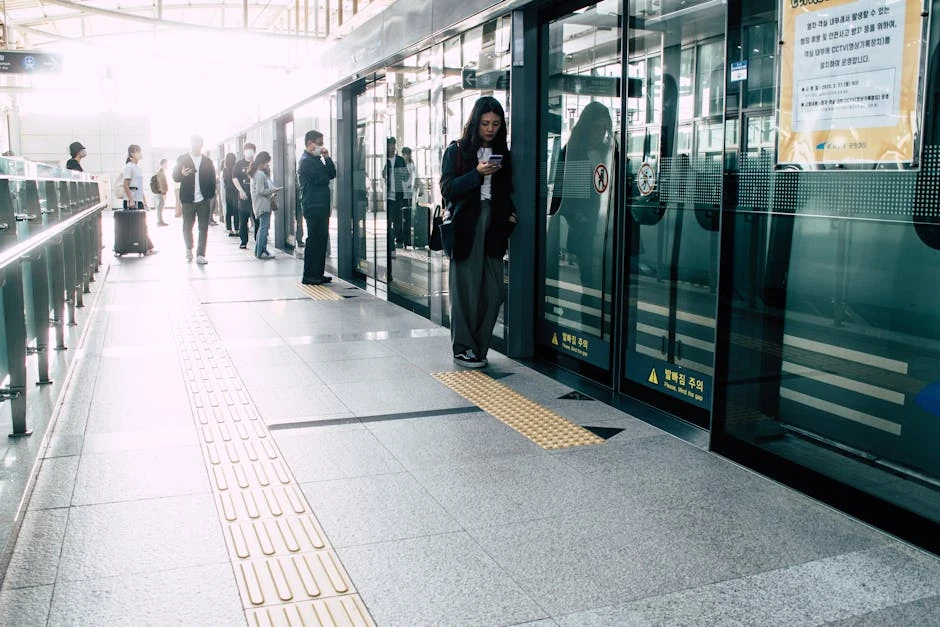
Seoul's subway is remarkably accessible. Every station has elevators (look for the elevator symbol near entrance maps), and platform screen doors are installed across all lines for safety. Priority seats — clearly marked in a different color at the ends of each car — are reserved for elderly passengers, pregnant women, and people with disabilities. Do not sit in these seats even if they're empty; locals will judge you silently and sometimes not so silently.
The trains are air-conditioned in summer and heated in winter, with underfloor heating on the seats. Free Wi-Fi is available on all trains and in stations. Bathrooms are available inside the paid zone at most stations, and they're generally clean.
Knowing Which Exit to Take
Major stations can have 15 or more exits, and picking the wrong one might drop you a 10-minute walk from your destination. Naver Map and KakaoMap will tell you the best exit number when you search for a destination. Get in the habit of checking before you arrive at your station.
Inside the station, overhead signs list the exit numbers with nearby landmarks and street names in both Korean and English. Take a moment to read these before climbing the stairs — it saves real time, especially at sprawling stations like Gangnam (12 exits) or Jongno 3-ga (15 exits).
Last Train Times: Don't Get Stranded
Last trains generally depart terminal stations between 11:00 PM and midnight, but the exact time varies by line, station, and direction. The last train from Gangnam on Line 2 toward City Hall, for example, leaves around 11:50 PM. But the last train from the same station toward Sadang might leave 15 minutes earlier.
Use the Subway Korea app or Naver Map to check the exact last train time for your specific route. If you're out late in Itaewon or Hongdae and the subway's closed, night buses (N-buses) cover major routes, and taxis are plentiful — though expect surge pricing between midnight and 4 AM.
Quick Reference: Seoul Subway Cheat Sheet
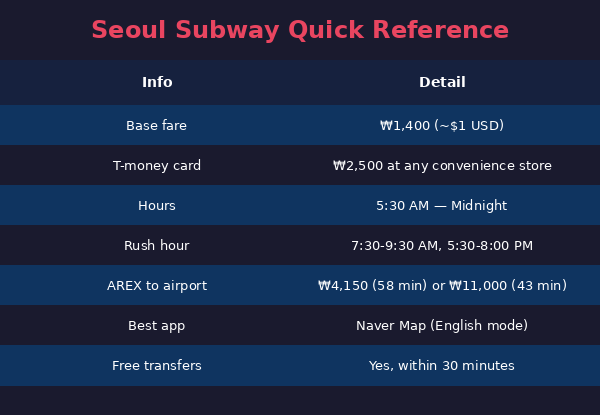
- Base fare: ₩1,400 (~$1 USD) with T-money, ₩1,500 with single-journey ticket
- T-money card cost: ₩2,500 (~$1.80 USD)
- Operating hours: ~5:30 AM to midnight
- Best app: Naver Map (set to English)
- Rush hour: 7:30–9:30 AM, 5:30–8:00 PM weekdays
- AREX Express to airport: ₩11,000, 43 minutes nonstop
- Free transfers: Yes, with T-money (within 30 minutes)
Frequently Asked Questions
Can I use Apple Pay or a credit card on the Seoul subway?
Not directly at the turnstiles — you need a T-money card or a mobile T-money integrated into Apple Pay or Samsung Pay. Regular contactless credit card tap doesn't work on subway gates. Get a T-money card or set up mobile T-money before your first ride.
Is the Seoul subway safe at night?
Extremely safe. Seoul consistently ranks as one of the safest major cities in the world. Late-night trains may be rowdy on weekends (soju does its thing), but violent incidents are vanishingly rare. Security cameras cover every car and platform.
Do I need to speak Korean to use the subway?
No. All signage is in English, announcements are made in English (plus Korean, Chinese, and Japanese), and the ticket machines have English-language options. With Naver Map on your phone, you can navigate the entire system without speaking a word of Korean.
Can I bring luggage on the subway?
Yes, there are no restrictions on bringing suitcases. However, during rush hour it's inconsiderate to block the aisles with large bags. If possible, travel with luggage during off-peak hours. The AREX All-Stop train has dedicated luggage racks.
What happens if I lose my T-money card?
Unfortunately, the remaining balance is gone unless you registered the card (most tourists don't). The good news is that T-money cards are cheap to replace. Buy a new one at any convenience store and reload it. Keep your card in a consistent spot — phone case, wallet, lanyard — so this doesn't happen.
Final Thoughts
Seoul's subway is genuinely one of the best ways to experience the city. It'll take you from ancient palaces to neon-lit nightlife districts for pocket change. Grab a T-money card, download Naver Map, and don't be afraid to explore lines you haven't planned for — some of the best discoveries in Seoul happen when you pop out of a random exit and find a street food alley you never knew existed.
For more on getting around Korea, check out our guides on transportation options across South Korea and essential Korea travel tips for first-timers.
Planning your Seoul trip? Save this guide to your phone — you'll reference it more than you think. And if you want more insider tips on navigating Korea like a local, subscribe to the Korea Insider newsletter for weekly travel advice delivered straight to your inbox.