
Boseong Travel Guide: Korea's Green Tea Fields & Beolgyo Cockle Clams (2026)
Somewhere in Korea's deep southwest, about 40 minutes past Gwangju, the landscape shifts. The flat rice paddies give way to soft, rolling hills — and those hills are covered in the most impossibly neat rows of green tea bushes you've ever seen. This is Boseong (보성), the small county that produces over 40% of Korea's green tea and is home to what might be the single most photographed agricultural landscape in the country.
Boseong doesn't have the tourist infrastructure of Seoul or Busan. There are no subway lines, no Starbucks on every corner, no neon-lit nightlife districts. What it has instead is a tea plantation that stops you mid-step, a neighboring town that serves the best cockle clams in Korea, and a winter light festival that draws hundreds of thousands despite the county's population of barely 40,000. It's the kind of place where you show up for three hours and end up rearranging your afternoon because you can't stop walking through the tea rows.
I came to Boseong as a half-day detour from Gwangju and left wishing I'd given it a full day. This guide will help you avoid that mistake.
If you're new to Korea entirely, start there for logistics. Then come back here for the green tea.
🎟️ Book Boseong Experiences
Why Boseong
Korea has a handful of green tea regions — Jeju's Osulloc gets the most international attention, Hadong in Gyeongsang province has its loyalists — but Boseong is the original. Tea cultivation here dates back over a thousand years, and the county has leaned into that identity harder than anywhere else. The terraced fields at Daehan Dawon are on tourism posters, drama backdrops, and the Instagram feeds of every Korean who's done the Jeolla road trip. For good reason: they're genuinely stunning.
Here's what makes Boseong worth the trip:
- Korea's most iconic tea plantation — Daehan Dawon's terraced green tea fields against a coastal mountain backdrop are the image people think of when they picture Korean green tea. The symmetry of the rows, the saturated green against red-brown earth, and the way morning mist clings to the hills — it's one of those rare places that looks better in person than in photos.
- Beolgyo cockle clams — The neighboring town of Beolgyo (벌교) is the cockle clam (꼬막, kkomak) capital of Korea. These tiny, ridged shellfish are a Jeollanam-do delicacy, and Beolgyo's tidal flats produce the best ones. November through March is peak season, and Koreans travel hours specifically to eat them here.
- The winter light festival — Every winter (roughly mid-November through early January), the tea plantation transforms into a massive LED light installation. Millions of lights draped across the tea bushes and surrounding hills. It draws 300,000+ visitors annually, which is remarkable for a county this small.
- Green tea everything — Ice cream, latte, rice cakes, noodles, pork cutlet, foot baths. Boseong has taken the concept of a regional specialty product and run with it further than most places dare. The green tea soft serve alone is worth the bus fare from Gwangju.
- Genuinely rural Korea — This is agricultural Korea, not tourist Korea. Old farmers tending fields, bus schedules measured in hours rather than minutes, ajummas running family restaurants with five-item menus. If you've only experienced Seoul and Busan, Boseong is a reset button.
Boseong won't fill a three-day itinerary. It doesn't need to. A focused day trip from Gwangju or a half-day stop on a Jeolla road trip gives you the plantation, a cockle clam lunch, and a green tea ice cream. That's a perfect day by any measure.
Getting There
Boseong is in the southern part of Jeollanam-do, about 1.5 hours south of Gwangju by bus. There's no train station in Boseong town itself, so buses are the primary option unless you're driving.
From Gwangju (Recommended Base)
Intercity buses run from Gwangju Bus Terminal (광주종합버스터미널, U-Square) to Boseong Bus Terminal roughly every 30–60 minutes. The ride takes about 1 hour 20 minutes to 1 hour 40 minutes depending on stops. Tickets cost around ₩8,000–₩10,000 one-way.
Gwangju is the most practical base for visiting Boseong. Stay in Gwangju, day-trip to Boseong, and combine it with Damyang on another day for a solid Jeolla itinerary.
Tip: Check bus times on Naver Map the night before. Rural bus schedules can shift, and you don't want to be stuck at Boseong terminal waiting two hours for the return.
From Seoul
There's no direct KTX to Boseong. Your best options:
- KTX to Gwangju Songjeong Station (about 1 hour 40 minutes, ~₩39,600), then taxi or metro to Gwangju Bus Terminal, then intercity bus to Boseong. Total travel time: roughly 3.5–4 hours.
- Express bus from Seoul to Boseong — Direct buses run from Seoul Express Bus Terminal (Central City) to Boseong a few times daily. The ride takes about 4 hours. Tickets around ₩25,000–₩30,000. Check bustago.or.kr for schedules.
- SRT to Suncheon, then local bus to Boseong (about 40 minutes). This is a decent alternative if you're also visiting Suncheon Bay or Yeosu.
For most travelers on a broader Korea itinerary, the Gwangju route makes the most sense because you'll probably want to see Gwangju and Damyang anyway.
From Boseong Terminal to Daehan Dawon
The tea plantation is about 8 km from Boseong Bus Terminal. Local buses run there (look for routes headed to 봇재 or 대한다원), but service is infrequent — maybe every 30–60 minutes. A taxi from the terminal costs around ₩10,000–₩12,000 and takes about 15 minutes. I'd recommend the taxi, especially if you're on a day trip and want to maximize time at the plantation.
Driving
If you've rented a car (which honestly makes Jeollanam-do much easier), Boseong is straightforward. Take the Namhae Expressway and exit at Boseong IC. The plantation has a large parking lot (₩3,000–₩5,000). Driving also lets you easily combine Boseong with Beolgyo for lunch and Suncheon Bay in the afternoon — a solid one-day Jeolla road trip loop.
Daehan Dawon Tea Plantation
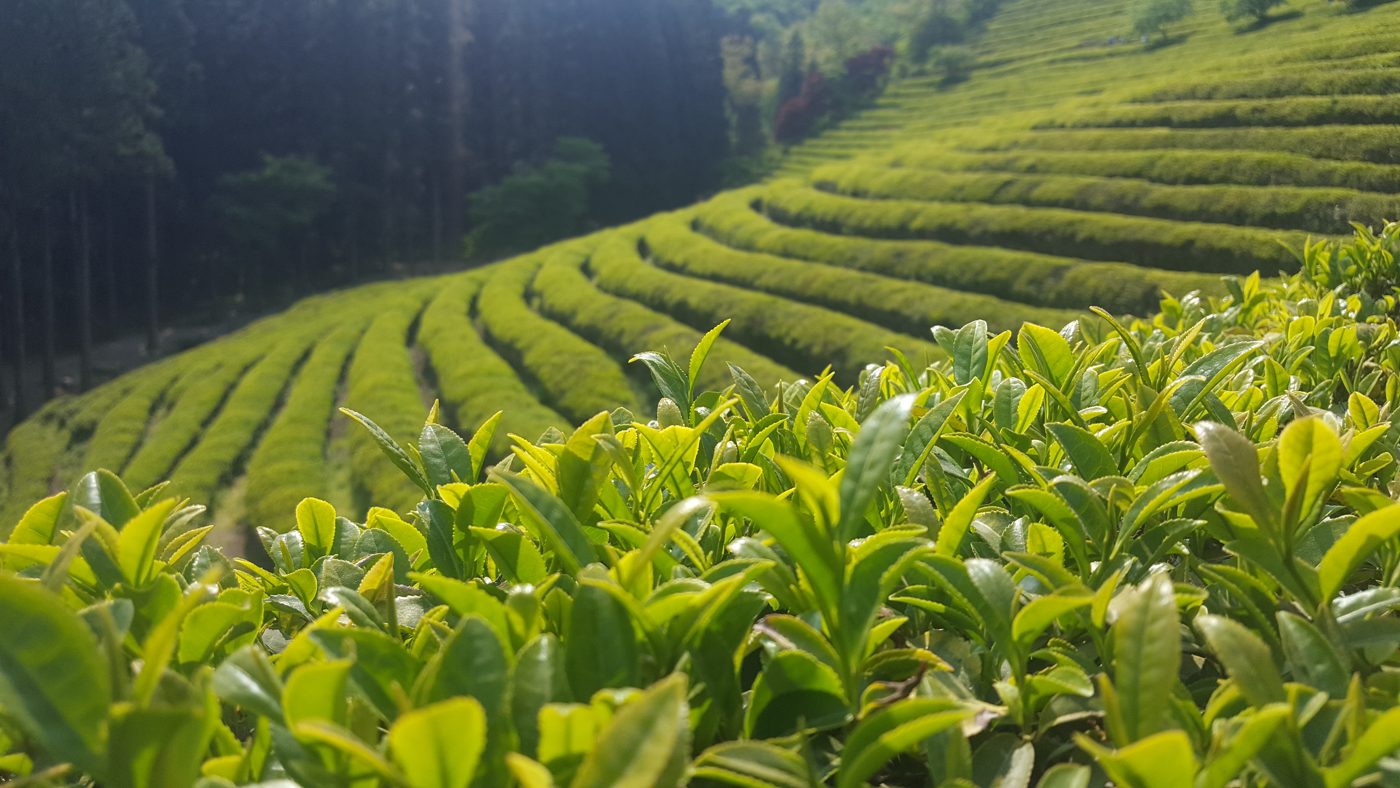
Daehan Dawon (대한다원) is the reason most people come to Boseong, and it delivers. Established in 1957, this is one of Korea's oldest commercial tea plantations, spread across hillsides that slope down toward the coast. The plantation is massive — about 660,000 square meters of tea fields — but the area open to visitors is well-defined with walking trails, viewpoints, and rest areas.
Admission is ₩5,000 for adults, ₩3,000 for children. The plantation is open year-round, though hours vary seasonally (typically 9:00 AM to 6:00 PM, with extended hours during light festival season).
The Terraced Fields
The money shot is the main terraced section near the entrance — the one you've seen in every photo and K-drama. Rows upon rows of neatly trimmed tea bushes climb the hillside in parallel lines that seem almost mathematically precise. From the bottom looking up, the effect is mesmerizing. From the top looking down toward the coast, it's even better.
The fields look different in every season:
- Spring (April–May) — Fresh green leaves, tea picking season, the most vibrant color. The first flush (첫물차) harvest in late April/early May is when the fields are at peak green. This is the postcard season.
- Summer (June–August) — Lush and dense. Hot and humid, but the deep green canopy is at its thickest. Fewer tourists than spring, which is a plus.
- Autumn (September–November) — The surrounding trees turn golden and red while the tea rows stay stubbornly green. The contrast is spectacular. Check the autumn foliage forecast to time your visit.
- Winter (December–February) — The tea bushes go dormant and turn brownish-green, but this is light festival season (see below), which is a completely different draw.
Walking Routes
The plantation has several marked trails ranging from easy strolls to moderate hill climbs:
- Main Terrace Loop (30–40 minutes) — The essential walk. Follows the main terraced section up to a hilltop viewpoint and loops back down. Mostly paved paths with some stairs. This is non-negotiable — it's the whole point of being here.
- Cypress Forest Path (20–30 minutes) — A shaded trail through a dense cypress grove adjacent to the tea fields. Cooler on hot days and a nice change of pace from the open hillside. The contrast between the dark forest and the bright green fields is great for photos.
- Coastal Viewpoint Trail (40–50 minutes) — A longer route that climbs to the highest point in the plantation with views toward the sea. Worth it if you have the time and the weather is clear. On a hazy day, skip it.
- Ecology Trail (20 minutes) — A shorter loop through wild tea plants and native vegetation. Quieter than the main terrace area. Good for a second visit or if you want to escape the crowds.
In total, plan for 1.5 to 2.5 hours at the plantation depending on your pace and how many photos you take. I spent two hours and could have spent a third.
Green Tea Ice Cream & Snacks
The plantation has several food stalls and a cafe near the entrance and along the main path. The green tea soft serve ice cream (녹차 소프트아이스크림, ₩4,000–₩5,000) is the signature snack and it's legitimately good — made with Boseong-grown tea, deeply green, bitter in the right way, and a cut above the mass-produced matcha ice cream you get elsewhere. Eat it sitting on a bench overlooking the fields. That's a moment.
Other options at the stalls:
- Green tea latte — ₩5,000–₩6,000. Made with locally ground tea powder. Better than chain-cafe versions.
- Green tea rice cake (녹차떡) — ₩3,000–₩4,000. Chewy tteok tinted green and mildly sweet.
- Green tea tteokgalbi — ₩8,000–₩10,000. Grilled meat patties with green tea mixed in. Sounds gimmicky but the tea actually cuts the richness nicely.
Photography Tips
A few practical notes for getting good photos:
- Morning light is best. The terraces face roughly southeast, so early morning (before 10:00 AM) gives you soft, directional light and fewer people. By midday in peak season, the main terrace area can get crowded.
- Shoot from above. The hilltop viewpoints looking down on the rows are more dramatic than shooting from field level. The symmetry reads better from altitude.
- Misty mornings are gold. If you're lucky enough to get morning fog, the fields look otherworldly. This happens more often in spring and autumn. Worth arriving early just for the chance.
- Stay on the paths. The tea plants are a working crop. Don't walk between the rows or touch the bushes. Plantation staff will tell you off, and rightfully so.
Winter Light Festival
Every winter, Daehan Dawon hosts the Boseong Tea Plantation Light Festival (보성차밭 빛축제), one of Korea's biggest winter illumination events. The entire tea plantation — plus the surrounding hillsides, pathways, and forest — is decorated with millions of LED lights in sprawling installations.
The festival typically runs from mid-November through early January (exact dates shift year to year — check the Boseong County tourism site closer to November). Hours are usually 5:00 PM to 10:00 PM, and the admission fee during the festival is ₩5,000 for adults.
What makes this one special compared to the dozens of light festivals Korea puts on every winter:
- The terrain — Draping lights over flat ground is one thing. Draping them across rolling tea terraces that curve up hillsides is another. The undulating landscape gives the festival a three-dimensional quality that flat-field festivals can't match.
- Scale — The installations cover a massive area. It's easily a 1–2 hour walk through the lit zones, and there are different themed sections (tunnel of lights, field illuminations, interactive installations, a lit-up cypress grove).
- The setting — You're in the Korean countryside at night. Stars overhead, cold mountain air, the smell of roasting sweet potatoes from vendors. It hits different than a city-based light show.
Practical notes: It gets cold — Boseong winter nights drop to -5°C or lower. Dress warmly, bring hand warmers. Weekends during the festival are packed. Go on a weekday evening if possible. The parking lot fills up fast on weekends, so arrive early or take a shuttle if one is running. Food stalls inside sell hotteok, odeng (fish cake skewers), and hot drinks, so you won't go hungry.
Beolgyo Cockle Clams
About 20 minutes southeast of Boseong by car (or a short bus ride from Boseong terminal), the small town of Beolgyo (벌교) is famous for exactly one thing: cockle clams. Known as kkomak (꼬막) in Korean, these small, ridged shellfish are harvested from the mudflats along the southern coast and have been a prized delicacy in Jeollanam-do for generations.
If you're visiting Boseong and not eating cockle clams in Beolgyo, you're doing it wrong.
What Are Cockle Clams?
Korean cockle clams (피꼬막 and 새꼬막 are the two main varieties) are small bivalves — about the size of a large thumbnail — with distinctive ridged shells. They're harvested by hand from tidal mudflats, mostly between November and March. The flavor is briny, slightly sweet, and chewy in a way that's addictive once you develop a taste for it.
There are three main types you'll encounter:
- 참꼬막 (chamkkomak) — The premium variety. Smaller, more flavorful, hand-harvested from deeper mud. More expensive and considered the best.
- 새꼬막 (saekkomak) — Larger, more commonly available, slightly less prized but still excellent. This is what you'll get in most set meals.
- 피꼬막 (pikkokak) — "Blood cockle" — has red-tinged flesh. Stronger flavor. Not everyone's cup of tea, but locals love it.
Where to Eat Cockle Clams
Beolgyo has an entire street of cockle clam restaurants near the Beolgyo Bus Terminal area. Most serve similar menus — the quality is consistent because the clams all come from the same local mudflats. Look for restaurants that are busy with Korean families (always the best indicator).
The standard order is a 꼬막 정식 (kkomak jeongsik) — a cockle clam set meal. This typically runs ₩15,000–₩25,000 per person and includes:
- Steamed cockle clams (삶은 꼬막) — the star, served warm in their shells
- Cockle clam bibimbap (꼬막비빔밥) — rice mixed with seasoned cockle clam meat, sesame oil, and vegetables
- Cockle clam jeon (꼬막전) — a savory pan-fried pancake studded with clam meat
- Various banchan — soup, kimchi, pickled vegetables, seaweed
The bibimbap is the sleeper hit. The combination of warm rice, the slightly chewy clam meat, and the sesame-chili dressing is deeply satisfying — and completely different from any bibimbap you've had before.
Seasonal Notes
Cockle clam season runs roughly November through March. Visit during this window for the freshest product and the fullest restaurant experience. Outside of season, most restaurants still serve cockle clams (frozen or preserved), but it's not the same. If you're in Boseong between April and October, the clams are fine but not transcendent. Plan accordingly.
The Beolgyo Cockle Clam Festival (벌교꼬막축제) usually runs for a few days in late October or early November, marking the start of the season. It features cooking demonstrations, clam-shucking contests, and heavily discounted set meals. Fun if your timing lines up.
Green Tea Experiences
Beyond walking through the fields and eating green tea ice cream, Boseong offers a few deeper tea experiences worth knowing about.
Green Tea Foot Bath
Several spots near Daehan Dawon and in Boseong town offer green tea foot baths (녹차 족욕), where you soak your feet in warm water infused with green tea leaves. It sounds like a tourist gimmick, and honestly, it partly is — but after a few hours of walking plantation trails, sinking your feet into warm green tea water feels genuinely restorative. Sessions typically cost ₩5,000–₩8,000 for about 20 minutes.
The Boseong Tea Museum area near the plantation sometimes has foot bath facilities. Ask at the plantation entrance for current availability — these setups change seasonally.
Tea Ceremony Experiences
A traditional Korean tea ceremony (다도, dado) is meditative, quiet, and nothing like a quick cafe stop. Several tea houses and cultural centers in the Boseong area offer abbreviated for visitors — typically 30–40 minutes where you learn the basic preparation methods, the correct way to hold the cup, and the philosophy behind Korean tea culture.
Prices range from ₩10,000–₩20,000 per person. The Boseong Tea Culture Center (보성다향문화센터) is one option; others are smaller private tea houses near the plantation. Availability can be hit-or-miss for walk-ins, so calling ahead or asking your accommodation to arrange one is smart. Even if you're not deeply into tea culture, watching an experienced tea master prepare a proper cup of Boseong green tea — slowly, deliberately, with respect for the leaves — recalibrates your pace in a way that Boseong encourages.
Tea Picking Experience
During harvest season (late April through May, with a second flush around June), some tea farms in the Boseong area offer tea-picking experiences where you put on the traditional hat and apron and pick fresh tea leaves by hand. These are usually arranged through the Boseong County Tourism Office or through guesthouse owners. Costs vary — some are free as part of seasonal promotions, others charge ₩10,000–₩15,000. It's seasonal and availability is limited, so don't plan your trip around it unless you've confirmed in advance.
Boseong Food Guide
Boseong's food identity splits into two lanes: green tea everything and cockle clams. Both are worth pursuing.
Green Tea Infused Food
Boseong has taken the "local specialty" concept and applied it to every conceivable food item. Some of these work brilliantly; others are novelties. Here's what's actually worth ordering:
- 녹차 냉면 (green tea naengmyeon) — Cold noodles made with green tea flour. ₩9,000–₩11,000. The noodles have a subtle earthy flavor and a pale green tint. Refreshing in summer, and the green tea adds a dimension that regular naengmyeon doesn't have. This one's a genuine winner.
- 녹차 삼겹살 (green tea samgyeopsal) — Pork belly marinated or wrapped with green tea. ₩13,000–₩16,000 per serving. The tea supposedly cuts the fattiness. I'm not sure about the science, but the flavor combination works.
- 녹차 돈까스 (green tea donkatsu) — Pork cutlet with a green tea-infused batter. ₩10,000–₩12,000. The coating has a faint herbal bitterness that complements the fried pork. Surprisingly good.
- 녹차 수제비 (green tea sujebi) — Hand-torn noodle soup with green tea dough. ₩8,000–₩10,000. Comfort food. The green tea flavor is gentle in the broth. Good for rainy days or cold weather visits.
- Green tea soft serve — Already mentioned above, but worth repeating. ₩4,000–₩5,000 at the plantation stalls. The benchmark Boseong snack.
Cockle Clam Set Meal
Covered in detail in the Beolgyo section above. The ₩15,000–₩25,000 kkomak jeongsik in Beolgyo is the single best meal you'll have in the Boseong area. Make it your lunch anchor.
Other Local Food
- 장어 (jangeo) — Freshwater eel, grilled or braised. Boseong's proximity to the coast and rivers means good eel restaurants. ₩20,000–₩30,000 per serving. Rich, fatty, and particularly popular in summer as a stamina food.
- Market food — Boseong's small traditional market (보성시장) has the standard Korean market spread: tteok, fish cake, sundae (blood sausage), seasonal fruit. Nothing unique to Boseong specifically, but a good place to grab cheap snacks.
Combining with Gwangju & Damyang
Boseong fits naturally into a Jeollanam-do itinerary centered on Gwangju. Here's how to structure it:
The Classic 3-Day Jeolla Loop
- Day 1: Damyang — Juknokwon bamboo forest, bamboo-themed lunch, Metasequoia Road. 40 minutes north of Gwangju by bus.
- Day 2: Boseong + Beolgyo — Daehan Dawon plantation in the morning, cockle clam lunch in Beolgyo, back to Gwangju by late afternoon. 1.5 hours south of Gwangju by bus.
- Day 3: Gwangju — 5.18 Memorial, Yangnim-dong, Songjeong Market, local food scene. The city itself deserves a full day.
This loop gives you Korea's bamboo capital, tea capital, and the cultural heart of Jeolla — three completely different experiences, all within 1.5 hours of Gwangju.
Extended Options
- Add Suncheon — Suncheon Bay Wetland Reserve and the Suncheon Bay National Garden are 30 minutes east of Beolgyo. If you have a car, Boseong → Beolgyo → Suncheon makes a natural day-trip arc.
- Add Yeosu — The coastal city of Yeosu is another 40 minutes past Suncheon by bus. Known for its night sea views, cable car, and seafood. Boseong + Yeosu works as a 2-day extension from Gwangju.
- Continue to Jeonju — From Gwangju, Jeonju is about 1.5 hours by bus. Adding Jeonju's hanok village and bibimbap to your Jeolla trip rounds out the region perfectly.
If you're building a full Korea itinerary, the Jeolla region (Gwangju, Damyang, Boseong, Jeonju) makes an excellent 4–5 day block between Seoul/Busan and the south coast.
Practical Tips
- Best time to visit: Spring (April–May) for the greenest fields and tea harvest season. Autumn (October–November) for foliage contrast and the start of cockle clam season. Winter (December–January) for the light festival. Summer works but is hot and humid.
- How much time: A full day is ideal — morning at the plantation, lunch in Beolgyo, back to Gwangju by evening. A half day works if you skip Beolgyo, but you'd be missing the cockle clams.
- Budget: Plantation admission ₩5,000, taxi from Boseong terminal ₩10,000–₩12,000, cockle clam lunch ₩15,000–₩25,000, green tea snacks ₩4,000–₩10,000. A full day costs roughly ₩50,000–₩80,000 including transport from Gwangju.
- Cash vs. card: Bring cash. The plantation and Beolgyo restaurants mostly accept cards, but smaller vendors, market stalls, and some rural buses are cash-only. ₩50,000–₩100,000 in cash should cover everything.
- Navigation: Naver Map is essential here. Google Maps has limited bus schedule data for rural Jeollanam-do. Naver will show you real-time bus arrivals and walking routes within the plantation area. Download offline maps for the Boseong area in case cell signal drops in the hills.
- Language: Minimal English spoken. Boseong is rural Korea — restaurant menus are mostly Korean-only, bus stops have Korean signage, and the plantation staff speak limited English. Naver Papago (translation app) or Google Translate's camera mode will get you through menus and signs. A few key phrases go a long way: "이거 주세요" (igeo juseyo, "this please") while pointing at a menu item covers most restaurant situations.
- Shoes: Wear comfortable walking shoes with some grip. The plantation paths have stairs and some sections can be slippery after rain. Heels and sandals are a bad idea.
- Connectivity: Check our Korea travel basics guide for SIM card and Wi-Fi advice. Cell reception is generally fine at the plantation and in town, but can get spotty on the longer hill trails.
FAQ
Can I visit Boseong as a day trip from Seoul?
Technically yes, but it's a stretch. Seoul to Boseong is 3.5–4 hours each way by the fastest route (KTX to Gwangju + bus to Boseong). That's 7–8 hours of travel for 2–3 hours at the plantation. I wouldn't recommend it. Instead, base yourself in Gwangju for a night or two and day-trip from there — the 1.5-hour bus ride each way is manageable and gives you a full day in Boseong and Beolgyo.
Is Boseong worth visiting outside of spring?
Absolutely. Each season has its appeal. Spring is the greenest, but autumn offers beautiful foliage contrast, winter has the light festival, and summer is lush even if it's hot. The cockle clam season (November–March) adds a major food incentive for winter visits. The only time I'd hesitate is early spring (March) or late autumn (late November) when the tea fields can look a bit dull before the growing season or after the last harvest — but even then, the landscape is still striking.
Do I need to book anything in advance?
For a regular day visit to the plantation, no — just show up and buy tickets at the gate. For the winter light festival on weekends, consider arriving early (before 5:30 PM) to avoid parking and entrance queues. Tea ceremony experiences and tea-picking sessions should be arranged in advance through the Boseong County Tourism Office or your accommodation. Cockle clam restaurants in Beolgyo don't take reservations — just walk in. During the Cockle Clam Festival in October/November, popular restaurants may have waits of 30+ minutes at peak lunch hours.