Korean Convenience Store Food Guide: What Tourists Are Actually Buying
Last updated: March 2026
Here's something nobody tells you before your first trip to Korea: you're going to spend an unreasonable amount of time in convenience stores. Not because you're being cheap (though you can eat incredibly well for under ₩5,000), but because Korean convenience stores are genuinely one of the best food experiences in the country.
CU, GS25, and 7-Eleven aren't just places to grab a bottle of water. They're mini food halls with fresh kimbap, hot meals, craft soju, seasonal desserts, and an ever-rotating lineup of limited-edition snacks that Koreans themselves queue up for. Foreign sales at Korean convenience stores have surged 60–100% in 2026, and the chains have noticed — they're actively stocking more tourist-friendly items and adding English labels.
This guide covers what's actually worth buying, what to skip, and which chain does what best. Consider this your companion piece to our Korean street food guide — between the two, you'll never go hungry in Korea.
If you want a guided introduction to Korean food culture beyond the convenience store, Korean street food and market tours on Klook pair tteokbokki stalls, pojangmacha (street carts), and traditional market tastings with a local guide — a worthwhile experience alongside doing your own convenience store runs.
The Essential Convenience Store Items Every Tourist Should Try
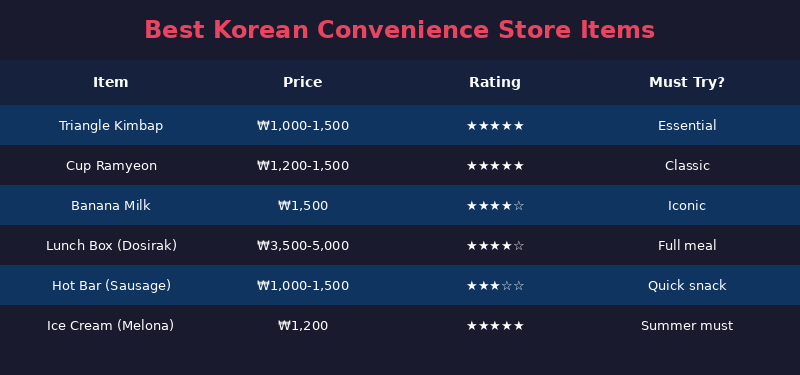
Triangle Kimbap (삼각김밥) — The ₩1,200 Meal
If there's one item that defines Korean convenience store culture, it's the samgak gimbap — a triangle of seasoned rice wrapped in crispy seaweed with a filling in the center. Think of it as Korea's answer to the Japanese onigiri, but with distinctly Korean flavors.
Price: ₩1,200–₩1,800 ($0.85–$1.25 USD)
Best fillings to try:
- Chamchi mayo (tuna mayo) — The classic. Safe, satisfying, universally loved.
- Bulgogi — Sweet marinated beef. Tastes better than it has any right to at this price.
- Kimchi chamchi (kimchi tuna) — Spicy, tangy, and the most "Korean" option.
- Jeyuk bokkeum (spicy pork) — Bold flavor, slightly spicy.
Pro tip: The packaging has a numbered opening sequence (1-2-3) printed on it. Follow it exactly or the seaweed rips and you'll be eating rice confetti. Seriously — there's a learning curve. Pull the top tab down first, then remove the left and right plastic panels. Koreans will absolutely watch you struggle with it and smile knowingly.
Best at: CU's premium line ("Baekjongwon" chef collaboration series) edges out the competition, but GS25 has the widest flavor selection.
Cup Ramyeon (컵라면) — The Late-Night Essential
Every Korean convenience store has a hot water dispenser and a microwave. This changes everything. You can buy a cup of ramyeon, fill it with hot water, and eat it at the counter or the outdoor seating area — and it legitimately qualifies as a meal.
Price: ₩1,500–₩3,500 ($1.05–$2.40 USD)
The tourist favorites:
- Shin Ramyun Cup (₩1,500) — The red one. Spicy beef broth. Korea's most iconic instant noodle. If you can handle medium spice, start here.
- Buldak Bokkeum Myun (₩2,200) — The black-and-red fire chicken one that went viral globally. It's genuinely very spicy. The "cheese" and "carbonara" versions are more manageable.
- Jin Ramen (₩1,500) — Milder than Shin Ramyun, richer broth. The "mild" version (blue label) is a good entry point for those sensitive to spice.
- Chapagetti Cup (₩1,800) — Black bean noodles in cup form. Not spicy. Savory and slightly sweet.
Power move: Buy a triangle kimbap and a cup ramyeon together. Koreans call this a combo and most stores sell them as a discounted set for ₩2,500–₩3,000 ($1.70–$2.05). That's a full, satisfying meal for under two dollars.
Best at: All chains are equal here — they stock the same brands. But GS25 stores tend to have the most seating.
Banana Milk (바나나맛 우유) — Korea's Comfort Drink
The squat, pear-shaped bottle of Binggrae Banana Milk is practically a Korean cultural artifact. It's been around since 1974, and Koreans have an emotional attachment to it that borders on religious. The taste is sweet, creamy, and unmistakably artificial banana — in the best way.
Price: ₩1,500–₩1,800 ($1.05–$1.25 USD) for the original; ₩2,000 ($1.40) for flavored variants
Variants worth trying:
- Original banana — Non-negotiable. Try this first.
- Strawberry — Sweet and pink.
- Melon — Seasonal, available spring/summer.
- Light — Reduced sugar version. Still sweet by Western standards.
Available at: Every single convenience store, supermarket, and vending machine in Korea. You literally cannot avoid it.
Soju (소주) — The National Spirit
Korea's best-selling alcoholic drink, and it's staggeringly cheap at convenience stores compared to bars and restaurants.
Price: ₩1,800–₩2,500 ($1.25–$1.70 USD) per 360ml bottle
What to know:
- Original (Chamisul Fresh) — 16.5% ABV. Clean, slightly sweet, goes down dangerously easy.
- Flavored soju — Peach, grape, grapefruit, green grape, plum. 12–13% ABV. These are the ones blowing up on social media. They taste like alcoholic juice, which is exactly the problem.
- Joeun Day (좋은데이) — Sweeter and smoother than Chamisul. Popular with younger drinkers.
Tourist tip: Convenience store soju is the same product you'd pay ₩5,000–₩8,000 for in a restaurant. Many tourists buy a few bottles at a convenience store and drink them at Han River parks — it's a quintessential Seoul experience. Drinking in public parks is legal in Korea.
Best selection: GS25 and CU both stock extensive flavored soju lineups. 7-Eleven tends to have fewer options.
Korean Ice Cream and Popsicles — Seriously Good
Korean convenience store ice cream is a category unto itself. The variety is staggering, the prices are low, and several items have become international cult favorites.
Price: ₩1,000–₩3,000 ($0.70–$2.05 USD)
Must-try items:
- Melona (₩1,200) — Melon-flavored ice bar. Creamy, refreshing, addictive. The most-sold Korean ice cream overseas.
- Samanco (₩1,500) — Fish-shaped ice cream sandwich filled with red bean. Sounds strange, tastes incredible.
- Babambar (₩1,200) — Red bean popsicle. A classic Korean summer staple.
- Jaws Bar (₩1,000) — Shark-shaped popsicle, blue and tangy. Kids love it, adults secretly love it too.
- Ssangsangbar (₩1,500) — Two-stick popsicle meant for sharing (or not — no judgment).
- Bravo Cone (₩2,000) — Waffle cone with vanilla and chocolate. Korea's answer to the Cornetto.
Best at: CU often has exclusive limited-edition flavors. GS25 runs 1+1 (buy-one-get-one) ice cream deals frequently — check the freezer labels.
Dosirak Lunch Boxes (도시락) — The Full Meal Deal
Korean convenience store lunch boxes are nothing like the sad pre-made sandwiches you'd find in Western convenience stores. These are proper multi-compartment meals with rice, a main protein, banchan (side dishes), and sometimes soup.
Price: ₩3,500–₩6,500 ($2.40–$4.50 USD)
Top picks:
- Baekjongwon Dosirak (CU exclusive, ₩5,500) — Created with celebrity chef Baek Jong-won. The kimchi fried rice and the jeyuk (spicy pork) versions are consistently excellent.
- Cheese Donkatsu Dosirak (₩4,500) — Breaded pork cutlet with cheese on rice. Comfort food in a plastic tray.
- Bibimbap Dosirak (₩4,000) — Mixed rice with vegetables and gochujang sauce. Heat it up in the in-store microwave.
Important: Always microwave these. Eating them cold is technically possible but spiritually wrong. The microwave is free to use — just ask the staff ("daewo juseyo" — please heat this up) or point at the microwave and they'll nod.
Best at: CU wins the lunch box category decisively, largely due to the Baekjongwon collaboration. GS25 is solid. 7-Eleven's selection is smaller.
Hot Bar and Fried Foods (핫바) — The Counter Snacks
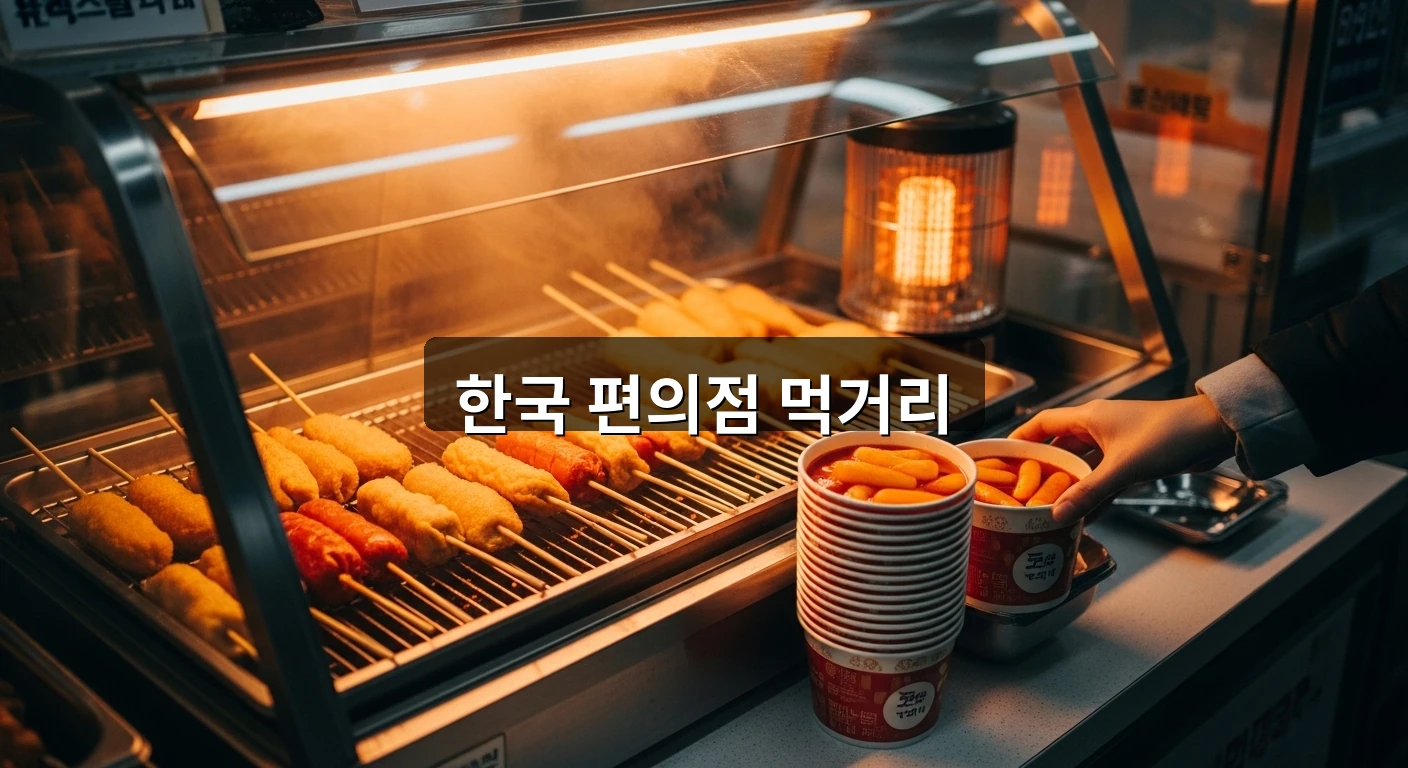
The glass warming case near the register holds some of the most underrated convenience store items. These are freshly made (or at least freshly heated) grab-and-go snacks.
Price: ₩1,500–₩3,500 ($1.05–$2.40 USD)
What's in the case:
- Hot bar (₩1,500–₩2,000) — A Korean-style fish cake or sausage on a stick. Simple, savory, perfect for walking and eating.
- Cheese hot bar (₩2,500) — Same thing, but with a molten cheese center. Extremely popular with tourists.
- Fried chicken pieces (₩3,000–₩3,500) — Surprisingly crispy and well-seasoned. GS25's fried chicken is particularly good.
- Corn dogs (₩2,500) — Korean-style, often coated in potato cubes or topped with sugar. The sweet-savory combination works.
- Steamed buns (₩1,500–₩2,000) — Available in winter. Filled with red bean, pizza, or curry.
Best at: GS25 has the most consistent hot food counter. CU is hit-or-miss depending on the location. 7-Eleven introduced a premium "Street Eleven" fried food line in late 2025 that's worth trying.
CU vs. GS25 vs. 7-Eleven: Which Chain Is Best?
All three are everywhere — you'll rarely walk more than 100 meters without hitting one in any Korean city. But they do have distinct strengths.
| Category | Best Chain | Why |
|---|---|---|
| Lunch boxes (dosirak) | CU | Baekjongwon collab, widest variety |
| Triangle kimbap | CU / GS25 (tie) | CU has premium line; GS25 has more flavors |
| Hot food counter | GS25 | Most consistent quality and variety |
| Ice cream deals | GS25 | Frequent 1+1 and 2+1 promotions |
| Drinks & alcohol | CU / GS25 (tie) | Similar range; CU has slightly more craft beer |
| Seating area | GS25 | More stores have indoor/outdoor seating |
| Exclusive snacks | CU | More limited-edition and collab items |
| Tourist-friendliness | 7-Eleven | More English signage, familiar brand |
The honest answer: Just go into whichever one you see first. The quality gap between chains is tiny. The real variable is how well-stocked and well-maintained the individual store is — a good CU beats a mediocre GS25 and vice versa.
Hidden Gems Most Tourists Miss
Fresh Sandwiches and Wraps
Korean convenience store sandwiches are far better than you'd expect. The egg salad sandwich (₩2,500 / $1.70) at any chain is a cult favorite. GS25's "Deli Express" line includes surprisingly good club sandwiches and chicken wraps for ₩3,000–₩4,000 ($2.05–$2.75).
Instant Coffee — Done Right
Korea runs on canned and bottled coffee. The ready-to-drink coffee section takes up an entire fridge door. TOP Coffee (Maxim brand, ₩1,800) and Georgia (₩1,500) are the staples. For something more premium, look for Starbucks bottled drinks (₩3,500) or Compose Coffee cans (₩2,000). In winter, these are available warm from a heated display.
Korean Snacks That Travel Well
Stocking up on souvenirs? These are the snacks Koreans actually eat (not just the tourist-marketed ones):
- Honey Butter Chips (₩2,200 / $1.50) — Sweet-salty potato chips that caused actual shortages when they launched.
- Choco Pie (₩4,500 / $3.10 for a box of 12) — Chocolate-covered marshmallow cake. Korea's answer to the Moon Pie, but better.
- Pepero (₩1,500 / $1.05) — Cookie sticks dipped in chocolate. Dozens of flavors.
- Market O Real Brownies (₩3,500 / $2.40) — Legitimately excellent brownies in a convenience store. Rich, fudgy, and well-packaged for gifts.
- Dried seaweed snacks (₩1,500 / $1.05) — Light, crispy, addictive. The sesame oil variety is the best.
Hangover Cures
Korea's drinking culture has produced an entire category of hangover drinks. They're stocked near the alcohol section (appropriate) and Koreans swear by them.
- Condition (₩3,500 / $2.40) — The market leader. Herbal, medicinal-tasting, drink before or after alcohol.
- Morning Care (₩3,000 / $2.05) — Slightly more palatable flavor.
- Dawn 808 (₩2,500 / $1.70) — The budget option. Works about as well as any of them.
Practical Tips for Convenience Store Shopping
- 1+1 and 2+1 deals: Look for bright yellow or red stickers on products. "1+1" means buy-one-get-one-free. "2+1" means buy two, get one free. These rotate weekly and can save you serious money.
- Payment: All stores accept T-money cards, credit cards, and Samsung/Apple Pay. Cash works too.
- Bags: Plastic bags cost ₩100–₩200. Bring your own or just carry your items.
- ATMs: Most CU and GS25 locations have ATMs that accept international cards. Withdrawal fees are typically ₩3,000–₩4,000 ($2–$3).
- Stamps/loyalty: CU has the "CU Pocket" app, GS25 has the "OUR HOME" app. If you're in Korea for more than a few days, signing up gets you member prices on certain items.
- Late night: Most stores are 24 hours. Post-midnight is when you'll find Koreans eating cup ramyeon at the counter — join them.
Frequently Asked Questions
How much can I save eating at convenience stores vs. restaurants?
A full convenience store meal (triangle kimbap + cup ramyeon + drink) costs ₩4,000–₩6,000 ($2.75–$4.10). A similar sit-down meal at a restaurant would be ₩8,000–₩12,000 ($5.50–$8.25). Over a week, that adds up — budget travelers regularly eat one or two convenience store meals per day and save ₩50,000+ ($35+) compared to eating out for every meal.
Is Korean convenience store food healthy?
It's a mixed bag. Triangle kimbap and certain lunch boxes are reasonably balanced. Cup ramyeon is high in sodium (1,500–2,000mg per cup). Fresh fruit, salads, and protein drinks are available if you're looking for healthier options. It's travel food — enjoy it without overthinking the macros.
Can I use convenience stores as a meal replacement while traveling?
Many budget travelers do exactly this for breakfasts and late-night meals, saving restaurant meals for lunch and dinner. It's a perfectly valid strategy, and the food quality is high enough that you won't feel like you're missing out. That said, Korean restaurant food is part of the experience — don't skip it entirely. Our street food guide has plenty of affordable options that are worth the slight price premium over convenience stores.
Do Korean convenience stores have vegetarian or vegan options?
Limited, but they exist. Vegetable triangle kimbap, plain rice rolls, fresh salads, fruit cups, and certain bread items are safe bets. However, many items that look vegetarian contain fish sauce, anchovy stock, or shrimp paste — Korean cuisine uses these as base flavors in almost everything. When in doubt, check for "비건" (vegan) labels, which some chains have started adding in 2025–2026.
What should I know before my first visit to Korea?
Convenience stores are just one piece of the puzzle. For the full picture on cultural norms, transport, money, and common tourist mistakes, check our essential things to know before visiting Korea guide.
Which convenience store chain has the most locations in Korea?
CU has the most stores nationwide (approximately 17,000+), followed closely by GS25 (approximately 16,500+). 7-Eleven comes in third with around 13,000 stores. In major tourist areas like Myeongdong, Hongdae, and Gangnam, all three chains are within a few steps of each other.