Korea Festival Calendar 2026: 13 Best Festivals Month-by-Month (For International Visitors)
Korea has 12+ flagship festivals — one for every month. Picking your travel month around them turns a generic Seoul trip into a season-locked experience, whether that means watching an entire volcanic cone catch fire on Jeju, wading through ten thousand people in a mud pit on Boryeong Beach, or floating a paper lantern down the Han River beneath Seoul's skyline. This calendar covers the 13 best festivals for international tourists, in order from May 2026 through April 2027.
Find hotels near each festival here. Browse festival tours and day trips here.
Quick-Pick: 13 Festivals by Month
| Month | Festival |
|---|---|
| May 2026 | Lotus Lantern Festival (Buddha's Birthday) |
| June 2026 | Gangneung Danoje Festival (UNESCO) |
| July 2026 | Boryeong Mud Festival |
| August 2026 | Busan Sea Festival |
| September 2026 | Andong Mask Dance Festival |
| October 2026 | Jinju Namgang Yudeung Festival (UNESCO) |
| October 2026 | Seoul International Fireworks Festival |
| November 2026 | Seoul Lantern Festival (Cheonggyecheon) |
| December 2026 | Garden of Morning Calm Lighting Festival |
| January 2027 | Hwacheon Sancheoneo Ice Festival |
| February 2027 | Taebaeksan Snow Festival |
| March 2027 | Jeju Fire Festival |
| April 2027 | Jinhae Cherry Blossom Festival |
May — Lotus Lantern Festival (Buddha's Birthday)
The Lotus Lantern Festival takes place in Seoul across late April and early May, culminating in a 3km lantern parade through central Seoul on the Saturday before Buddha's Birthday. Tens of thousands of hand-held lotus lanterns move from Dongdaemun through Jongno toward Jogyesa Temple — one of the most photogenic nights in the Korean calendar. Entry is free and the parade is open to international visitors who want to carry a lantern.
June — Gangneung Danoje Festival (UNESCO)
The Gangneung Danoje Festival is one of Korea's two UNESCO-listed festivals, held in Gangneung on the East Sea coast in late May through early June. The festival preserves 1,000-year-old shamanist rituals, mask dances (gwanno mask play), and the ritual washing of hair in iris-infused water from the Namdae Stream. It runs for five days with a large street market, and Gangneung is a 2-hour KTX ride from Seoul — a natural two-night add-on if you're heading to Korea's east coast.
July — Boryeong Mud Festival
The Boryeong Mud Festival at Daecheon Beach is the most internationally known festival in Korea — an entire beach resort taken over by mud pools, mud slides, and mud wrestling for two weeks in July. Boryeong's coastal mud is marketed for cosmetic properties, but the appeal for most international visitors is simpler: it's a beach party with a completely unhinged premise. It's 2 hours from Seoul by intercity bus, accommodation in the beach guesthouses sells out months ahead, and the entrance wristband covers all mud attractions.
August — Busan Sea Festival
The Busan Sea Festival runs across Haeundae and Gwangalli beaches throughout August — the peak of Korean beach season. The festival combines sand sculpture competitions, drone light shows over the sea, K-pop performances, and the dramatic backdrop of Gwangan Bridge lit at night. August is Busan's busiest month; book hotels on or near Haeundae at least 6 weeks in advance, and take the KTX from Seoul (2.5 hours, from ₩60,000).
September — Andong Mask Dance Festival
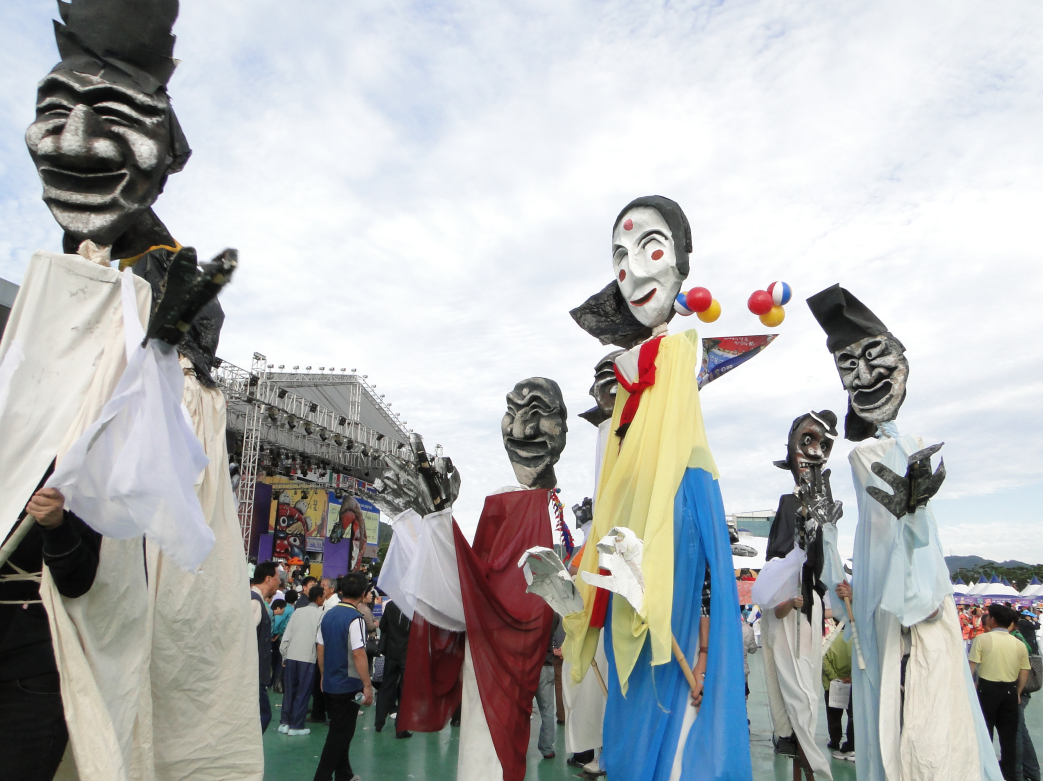
The Andong Mask Dance Festival is a 9-day festival in Andong (North Gyeongsang Province) in late September, centered on the Hahoe Folk Village — a UNESCO World Heritage Site. Traditional mask dance performances from Korea and international folk troupes fill the village lanes and open-air stages, and the festival coincides with autumn foliage beginning to turn in the surrounding mountains. Andong is 2 hours from Seoul by KTX or 2.5 hours by intercity bus, and it's one of the most culturally immersive festivals on this list.
October — Two Flagship Events
October is Korea's best festival month. The Jinju Namgang Yudeung Festival (UNESCO) fills the Nam River in Jinju, South Gyeongsang Province, with thousands of silk lanterns over 9 nights — a 600-year-old tradition originally lit in memory of those who died in the Imjin War. The same month, the Seoul International Fireworks Festival at Yeouido Han River Park is Korea's largest fireworks event, drawing over 1 million spectators for a 60-minute display by Korean and international pyrotechnic teams. Pairing Andong (late September) with Jinju (early October) is the best back-to-back festival trip in Korea — 1 hour apart by intercity bus.
November — Seoul Lantern Festival (Cheonggyecheon)
The Seoul Lantern Festival lights up the Cheonggyecheon Stream in central Seoul with 50,000+ lantern installations across two weeks in November. Unlike the Lotus Lantern parade (which is moving), this is a slow walk along a 2km illuminated stream running below street level through the heart of the city — free to enter and spectacular at night. November is shoulder season in Seoul — cheaper hotels, thinner crowds — making this one of the best-value festival windows of the year.
December — Garden of Morning Calm Lighting Festival
The Garden of Morning Calm Lighting Festival runs from November through March at the Garden of Morning Calm in Gapyeong, Gyeonggi Province — a 90-minute train ride from Seoul. The private botanical garden installs around 5 million lights across its 330,000m² grounds each winter, creating a fantasy-landscape of illuminated paths, flower fields, and pavilions. It's a popular date-trip from Seoul throughout the winter and a family staple in December.
January 2027 — Hwacheon Sancheoneo Ice Festival
The Hwacheon Sancheoneo Ice Festival in Gangwon Province is the most distinctive winter festival in Korea — a week-long event on a frozen mountain river where visitors drill holes in the ice and fish for sancheoneo (mountain trout). It also includes sledding, ice sculpture parks, and the spectacle of a frozen river crowded with thousands of bundled-up Koreans drilling through the ice simultaneously. Hwacheon is 2.5 hours from Seoul by intercity bus; the festival is typically the second and third weeks of January.
February 2027 — Taebaeksan Snow Festival
The Taebaeksan Snow Festival sits at the foot of Taebaeksan Mountain in Gangwon Province, held in late January through early February when the mountain reliably holds deep snow. The festival features massive snow and ice sculptures, a snow sled track, and the option to hike the snow-covered summit (1,567m) via a well-maintained trail — one of the most scenic winter hikes in Korea. Taebaek is about 3 hours from Seoul by KTX to Taebaek Station.
March 2027 — Jeju Fire Festival
The Jeju Fire Festival at Saebyeol Oreum in Aewol is the most visually spectacular festival in Korea — a 519m volcanic cone deliberately set ablaze at sunset while drone shows and fireworks play below. The festival runs across a week in mid-March, but the burn ceremony is the main night. Jeju is a 1-hour domestic flight from Seoul Gimpo; flights for festival weekend sell out 3–4 weeks ahead and should be booked as soon as dates are confirmed.
April 2027 — Jinhae Cherry Blossom Festival
The Jinhae Cherry Blossom Festival (Gunhangje) in Changwon, South Gyeongsang Province is Korea's largest cherry blossom festival — 360,000 cherry trees across a naval port city, the most famous image being the Yeojwa Stream lined with overhanging blossoms. The festival runs for 10 days in late March and early April (exact timing depends on the bloom forecast), and the venue transforms into one of the most photographed spring landscapes in all of Asia. Take the KTX to Changwon or Masan, then a short bus to Jinhae.
How to Plan Around Festivals
A few principles that make a big difference when timing a Korea trip around festivals:
1. Book accommodation 2 months ahead for the big three. Boryeong Mud Festival, Jinhae Cherry Blossom, and Hwacheon Ice Festival all have extremely limited accommodation near the venues. For Boryeong, the beachfront guesthouses sell out by May for a July festival. For Jinhae, the bloom window is only 7–10 days and the whole town fills. Book the moment official dates are announced, and search here for availability.
2. KTX vs intercity bus — know when each makes sense. KTX (high-speed rail) reaches Busan (2.5h), Gyeongju, Andong, and Jinju with connections from Seoul Station. For festival venues not on the KTX line — Boryeong, Hwacheon, Gangneung — intercity buses from Seoul Express Bus Terminal are often faster door-to-door and significantly cheaper (₩10,000–25,000 one-way vs ₩50,000+ on KTX).
3. The best back-to-back pairing is Andong + Jinju in October. Andong Mask Dance (late September) and Jinju Namgang Yudeung (early October) are only 1 hour apart by intercity bus, and both are in the south of Korea where October weather is reliably clear and cool. A 5-night Gyeongsang Province trip — Seoul → Andong (2 nights) → Gyeongju (1 night) → Jinju (2 nights) → Seoul or Busan — hits two UNESCO-listed festival experiences and Korea's best historic site in a single loop.
Related Korea Travel Guides
- Korea Festivals 2026 — Complete Hub — overview of all major festivals with dates and tips.
- Jeju Island Complete Travel Guide — full Jeju trip planning for the Fire Festival and beyond.
- Seoul 3-Day Itinerary — base itinerary for festival trips that start and end in Seoul.
- Where to Stay in Seoul — neighbourhood guide for pre- and post-festival Seoul nights.
FAQ
What's the best month to visit Korea for festivals?
October. The Jinju Namgang Yudeung Festival and Seoul International Fireworks Festival both fall in October, the weather is consistently clear and cool (10–18°C), and autumn foliage begins across the country. May is a close second — the Lotus Lantern parade is one of the most beautiful events in Asia, and spring temperatures are ideal for outdoor crowds.
Are these festivals free?
Most are free to enter: Lotus Lantern Festival, Gangneung Danoje, Seoul Lantern Festival, Jinju Yudeung, and the Seoul Fireworks are all free for spectators. Boryeong Mud Festival charges an entrance wristband (around ₩20,000). Garden of Morning Calm Lighting Festival is a private garden with paid admission (around ₩11,000 for adults). Hwacheon Ice Festival charges for ice fishing activity but not general entry.
Do I need to book festival experiences in advance?
For accommodation near festival venues — yes, absolutely, and often 6–8 weeks ahead. For the festival activities themselves, most are walk-up. The main exceptions are KTX and domestic flights to Jeju for the Fire Festival (book as soon as official dates are announced), and guided festival tours via Klook which sell out for the main event nights.
What about Chuseok and Lunar New Year — aren't those major events?
Chuseok and Seollal (Lunar New Year) are national holidays, not public festivals. During both periods, Koreans travel home to family — tourist sites are often closed, transport is severely congested, and many restaurants in cities shut for several days. For international tourists, traveling during these windows is generally not recommended unless you specifically want to experience the family-holiday atmosphere. See the Korea Festivals 2026 hub for dates to avoid.