Korea Buddha's Birthday & Lotus Lantern Festival 2026: Complete Guide
Every May, Seoul transforms into a river of light. Tens of thousands of handmade lotus lanterns flood the streets from Dongdaemun to Jogyesa Temple in one of Asia's most visually stunning parades. Buddha's Birthday (석가탄신일) falls on Monday, May 5, 2026 — a national holiday — and the Lotus Lantern Festival runs for the entire weekend before it.
If you're planning a Korea trip for late April or May, this is the event to build your itinerary around. Here's everything you need to know — and how to book.
Book Your Lantern Festival Experience
Temple stays, lantern-making workshops, and Seoul cultural tours — book early, these sell out:
2026 Festival Dates & Schedule
Buddha's Birthday follows the lunar calendar, so the date shifts each year. In 2026:
| Event | Date | Time | Location |
|---|---|---|---|
| Lantern-Making Workshop | May 1–4 (Fri–Mon) | 10:00–17:00 | Jogyesa Temple grounds |
| Cultural Festival | May 2–3 (Sat–Sun) | 10:00–21:00 | Jonggak area & Jogyesa |
| Lotus Lantern Parade | May 3 (Sat) | 19:00–21:30 | Dongdaemun → Jogyesa (Jongno) |
| Yeongsan Jae Ceremony | May 4 (Sun) | 10:00–12:00 | Jogyesa Temple |
| Buddha's Birthday (public holiday) | May 5 (Mon) | All day | Nationwide |
Planning tip: Arrive by May 1 (Friday) to catch the full festival weekend. This also means you get the Monday public holiday — a perfect 4-day trip from Friday to Monday.
What Is Buddha's Birthday in Korea?
Known as 부처님 오신 날 (Bucheonim Osin Nal — "the day Buddha came"), this is one of Korea's most visually striking holidays. For weeks before May 5, temples across the country string up thousands of coloured lotus lanterns. Streets glow. Temples offer free tea and rice cakes to anyone who visits.
It's a national public holiday — banks, government offices, and some businesses close. But tourist attractions, restaurants, and shops stay open. In fact, it's one of the best days to visit a Korean temple because the atmosphere is electric.
The Lotus Lantern Parade (연등회)
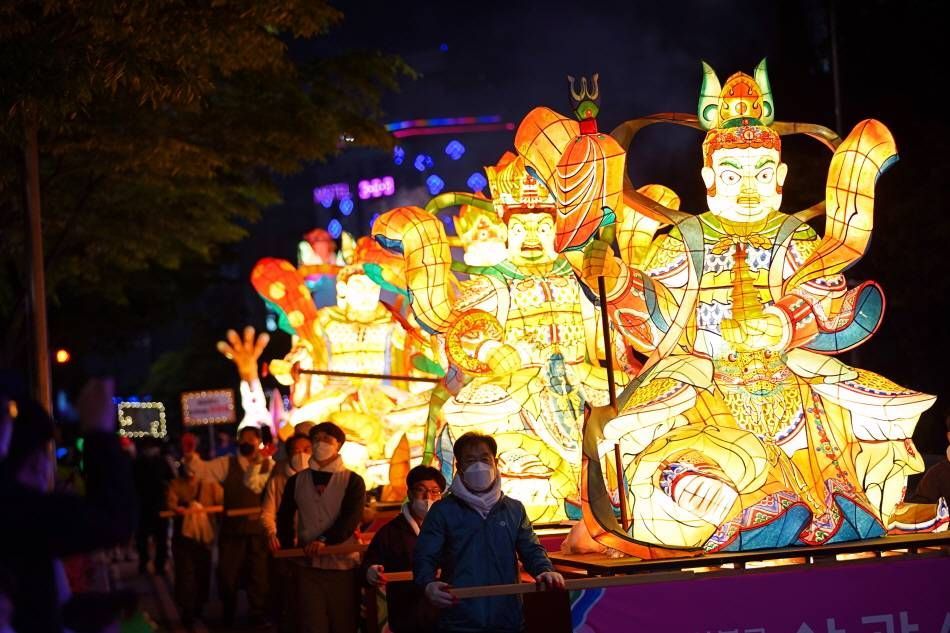
The main event. 100,000+ lanterns carried by tens of thousands of participants through central Seoul. The parade is a UNESCO Intangible Cultural Heritage since 2020 — it's that significant.
The Route
The parade starts at Dongdaemun Gate and flows west along Jongno (종로) to Jogyesa Temple, roughly 3 km. The entire route is lined with spectators — arrive early to get a spot.
What You'll See
- Giant float lanterns — massive dragon, lotus, and elephant lanterns that tower above the crowd
- Individual lanterns — thousands of people carrying personal lotus lanterns, many handmade at workshops
- Temple groups — each Korean Buddhist temple sends a delegation with their own themed lanterns
- International section — Buddhist communities from other countries participate
- Music & dance — traditional Korean drums, Buddhist chanting, and performances along the route
Best Viewing Spots
| Spot | Why | Arrive By |
|---|---|---|
| Jonggak Station (Exit 1) | Centre of the route, best for photography | 17:30 |
| Jongno 3-ga Station | Near the climax as lanterns approach Jogyesa | 18:00 |
| Dongdaemun Gate area | See the start — less crowded, good for families | 18:30 |
| Jogyesa Temple | The finale — all lanterns converge here | 17:00 (most crowded) |
Join the parade yourself! Foreigners can participate. Register at the Lotus Lantern Festival website or join through a temple stay program. You'll carry your own lantern — an unforgettable experience.
Book a Guided Lantern Parade Tour
Don't navigate the crowds alone — guided tours include prime viewing spots, cultural context, and often a lantern-making workshop beforehand.
Jogyesa Temple — Heart of the Festival
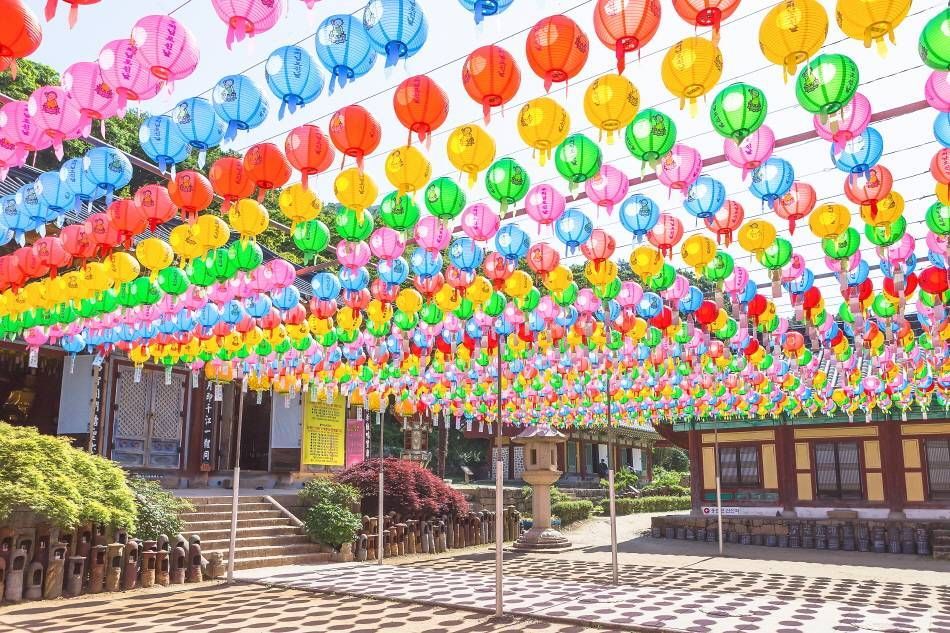
Jogyesa (조계사) is the chief temple of the Jogye Order, Korea's largest Buddhist sect. During festival week, the entire temple complex is draped in thousands of lotus lanterns — it's one of the most photographed scenes in Korea.
What to Do at Jogyesa
- Walk through the lantern canopy — the courtyard is covered in rows of lanterns, each with a prayer tag
- Free tea & temple food — served to visitors on Buddha's Birthday
- Lantern-making workshop — make your own lotus lantern (free or small fee, May 1–4)
- Traditional culture booths — try Buddhist calligraphy, bracelet-making, woodblock printing
- Main ceremony — the Yeongsan Jae on May 4 is a rare chance to see an elaborate Buddhist ritual
📍 55 Ujeongguk-ro, Jongno-gu, Seoul | Subway: Anguk Station (Line 3, Exit 6) or Jonggak Station (Line 1, Exit 2)
Lantern-Making & Cultural Activities
The festival isn't just spectating — it's participating. These are the hands-on experiences available:
1. Lotus Lantern Making Workshop
Build your own traditional lotus lantern using wire, coloured paper, and LED candles. Sessions run May 1–4 at Jogyesa and in the festival area around Jonggak. Free for most sessions, but premium workshops (larger, more elaborate lanterns) may charge 5,000–10,000 KRW.
2. Temple Food Experience
Korean temple food (사찰음식) is entirely vegan, exquisitely prepared, and nothing like what you'd expect from "monastery food." Several temples offer cooking classes and tasting sessions during the festival period.
Book a Temple Food Experience
Hands-on Korean temple food cooking classes — learn from Buddhist monks.
3. Tea Ceremony
Traditional Korean tea ceremonies are offered at temples throughout Seoul during the festival. A calm contrast to the parade energy — sit on a tatami floor, learn the ritual, and drink hand-roasted green tea.
4. Hanbok Experience
Many visitors pair the festival with wearing hanbok (traditional Korean clothing). Rental shops surround the Jogyesa/Bukchon area, and wearing hanbok gets you free entry to nearby palaces.
Rent Hanbok for the Festival
Premium hanbok rental with photo packages — perfect for lantern-lit evening photos.
Temple Stays During the Festival
A temple stay (템플스테이) during Buddha's Birthday is the ultimate immersion. You sleep in a working Buddhist temple, wake at 4 AM for morning chanting, eat temple food, meditate, and often join the lantern parade with the temple's group.
Best Temple Stays Near Seoul
| Temple | Location | Duration | Price (approx.) | Highlights |
|---|---|---|---|---|
| Jogyesa | Central Seoul | 1 night | 70,000 KRW | Heart of the festival, join the parade |
| Bongeunsa | Gangnam, Seoul | 1 night | 60,000 KRW | Modern temple, English programs |
| Gilsangsa | Seongbuk-dong, Seoul | 1 night | 50,000 KRW | Peaceful mountain setting, beautiful gardens |
| Geumsunsa | Bukhansan, Seoul | 2 nights | 100,000 KRW | Mountain temple, hiking + meditation |
| Haeinsa | Hapcheon (3h from Seoul) | 2 nights | 80,000 KRW | UNESCO site, Tripitaka Koreana |
Book early! Temple stays during Buddha's Birthday week sell out weeks in advance. The official portal is eng.templestay.com, or book through Klook for English-language support.
Book a Temple Stay
Overnight temple experiences with meditation, chanting, and temple food — book now before Buddha's Birthday slots fill up.
Where to Stay
For the Lantern Festival, you want to be in Jongno-gu — walking distance from Jogyesa Temple and the parade route. Here are the best areas:
Best Neighbourhoods for the Festival
| Area | Why | Budget (per night) |
|---|---|---|
| Insadong / Anguk | 5 min walk to Jogyesa, traditional vibe, tea houses | 80,000–200,000 KRW |
| Jongno / Jonggak | On the parade route — watch from your hotel window | 70,000–180,000 KRW |
| Myeongdong | 10 min subway, great for shopping + food | 90,000–250,000 KRW |
| Hongdae | Budget-friendly, nightlife, 20 min subway | 40,000–120,000 KRW |
Book Your Hotel for Lantern Festival Weekend
May is peak season in Seoul — hotels near the parade route fill up fast. Book now for the best rates.
How to Get There
To Jogyesa Temple
- Subway: Anguk Station (Line 3, Exit 6) — 5 min walk. Or Jonggak Station (Line 1, Exit 2) — 3 min walk.
- Bus: Routes 109, 151, 162, 171, 172, 272, 601 stop near Jogyesa
- From Incheon Airport: Airport Railroad (AREX) to Seoul Station → transfer to Line 1 → Jonggak Station (total ~80 min)
Parade Route Access
On parade night (May 3), roads along Jongno are closed to traffic from 17:00. The best subway stations for the parade:
- Start of parade: Dongdaemun Station (Lines 1, 4)
- Middle of route: Jongno 3-ga Station (Lines 1, 3, 5)
- End of parade: Anguk Station (Line 3) or Jonggak Station (Line 1)
Get a T-money Card or Rail Pass
You'll need a T-money card for Seoul's subway. If you're also visiting Busan, Gyeongju, or other cities, a KR Pass saves money on KTX trains.
Practical Tips
What to Wear
- Early May in Seoul: 15–22°C during the day, 10–14°C at night
- Bring a light jacket for the evening parade — you'll be standing for 2+ hours
- Comfortable walking shoes — the parade route is 3 km and you'll be on your feet
- If visiting temples: cover shoulders and knees (casual is fine, just not beachwear)
Photography Tips
- The parade is best photographed at dusk (around 19:00–19:30) when lanterns glow against the fading sky
- Jogyesa Temple's lantern canopy is best photographed at night — the colours are more vivid
- Bring a tripod or monopod — you'll want long exposures for the lantern glow
- The float lanterns are best captured from a slightly elevated position — try the steps near Jonggak Station
Food During the Festival
- Free temple food at Jogyesa and other temples on May 5
- Street food vendors line the parade route — tteokbokki, hotteok, bungeoppang
- The Insadong area has dozens of traditional Korean restaurants within walking distance
Crowds & Safety
- Expect 200,000+ people along the parade route
- It's very safe — heavy police presence, well-organized
- Keep belongings in front pockets or a crossbody bag
- Subway stations near the route will be packed 17:00–22:00 — consider walking one station further
Celebrations Outside Seoul
While Seoul has the biggest parade, Buddha's Birthday is celebrated at every Buddhist temple in Korea. Some notable alternatives:
| Temple | City | Why Visit |
|---|---|---|
| Beomeosa | Busan | Stunning mountain temple, large lantern display, fewer tourists |
| Haeinsa | Hapcheon | UNESCO World Heritage, home of the Tripitaka Koreana woodblocks |
| Bulguksa | Gyeongju | Korea's most famous temple, UNESCO site, beautiful grounds |
| Yakcheonsa | Jeju | Largest temple in Asia, ocean views, quieter celebration |
| Tongdosa | Yangsan | One of Korea's "Three Jewel Temples," elaborate rituals |
Explore Temples Across Korea
Combine Buddha's Birthday with a temple tour — visit Seoul, Gyeongju, and Busan's most iconic temples.
FAQ
Is Buddha's Birthday a public holiday?
Yes. May 5, 2026 is a national holiday. Most government offices and banks close. Tourist attractions, restaurants, and shops remain open — in fact, many have extended hours.
Is the Lotus Lantern Parade free?
Yes, completely free to watch. No tickets needed. Just show up along the route by 18:00 to secure a good viewing spot.
Can I participate in the parade?
Yes! Foreigners are welcome. Register through the official Lotus Lantern Festival website or sign up via a temple stay program. You'll carry a lantern with a temple group.
Do I need to be Buddhist to attend?
Absolutely not. The festival welcomes everyone regardless of religion. Koreans of all backgrounds attend. It's as much a cultural event as a religious one.
What if it rains?
The parade goes ahead in light rain — lanterns are designed for it. In heavy rain, check the official website for updates. Bring a clear poncho (not an umbrella — they block views behind you).
Is it good for kids?
Excellent. Lantern-making workshops are kid-friendly, the parade is magical for children, and the free temple food is a fun experience. Just be prepared for large crowds during the parade.
How early should I book accommodation?
At least 4–6 weeks before. Hotels in Jongno and Insadong sell out for this weekend. Book now if you're reading this in March or April.
Ready to Plan Your Lantern Festival Trip?
The best experiences sell out weeks ahead. Book now:
Last updated: March 2026. Dates are based on the 2026 Korean lunar calendar. Check the official Lotus Lantern Festival website for final schedule confirmation.
Related Guides