Where to Stay in Incheon 2026 — Airport, Songdo & Chinatown Guide
Most people never give Incheon a second thought. They land at the airport, hop on the AREX to Seoul, and that's that. But Incheon is a proper city — 3 million people, Korea's oldest Chinatown, a futuristic smart city built on reclaimed tidal flats, and one of the most atmospheric waterfront districts in the country. Staying a night or two here instead of commuting from Seoul changes the whole trip.
This guide covers where to stay in Incheon depending on what you're actually here to do: catch an early flight, explore Songdo's canals, eat jjajangmyeon in Chinatown, or watch the sun set over Wolmido's harbour. Each neighbourhood has a different character and price point, and choosing the wrong one wastes significant time on transit.
For the full picture of what Incheon offers, see our Incheon Travel Guide. For airport transfer options, see Incheon Airport to Seoul.
Quick Answer: Which Area to Choose
- Near Incheon Airport: for early departures, late arrivals, or one-night layovers — 10 minutes to Terminal 1 by taxi, paradise resort casino nearby, no transit stress
- Songdo IBD: for families, business travellers, or anyone who wants a clean, modern, walkable base — Central Park waterfront, roof pools, international restaurants, easy metro access to the airport
- Chinatown / Jung-gu: for travellers who want character and atmosphere — Korea's only genuine Chinatown, Open Port heritage district, a 20-minute walk to Wolmido harbour
- Bupyeong: for budget travellers or those doing a longer Incheon stay — well-connected metro hub, Korean street food, lowest prices in the city
- How to book in English: Trip.com has the strongest Incheon inventory including properties near the airport that do not appear elsewhere. Booking.com covers the main chains well.
- Prices checked: May 2026
Neighbourhood Comparison Table
| Area | Best For | Price Range | Airport Distance | Vibe |
|---|---|---|---|---|
| Near Airport (Unseo) | Layovers, early/late flights | about ₩80,000–300,000/night | 5–15 min by taxi | Functional, international, resort-adjacent |
| Songdo IBD | Families, business, modern comfort | about ₩100,000–350,000/night | 30–40 min by metro | Sleek, walkable, green, waterfront |
| Chinatown / Jung-gu | Sightseeing, atmosphere, history | about ₩60,000–160,000/night | 50–60 min by AREX + metro | Gritty, atmospheric, walkable to harbour |
| Bupyeong | Budget travel, longer stays | about ₩40,000–120,000/night | 45 min by metro | Local, busy, commercial, no-frills |
Near Incheon Airport (Unseo & Yeongjong Island)
If you have an early morning flight out of Incheon, staying near the airport the night before is worth serious consideration. Terminal 1 is about 10 minutes by taxi from the cluster of hotels on Yeongjong Island — that is the difference between a 4am alarm and a 5:30am alarm. For anyone on a long layover of 8 hours or more, this area also makes sense as a base: you clear immigration, check in, rest, then re-clear security without the stress of getting back from Seoul.
The airport area has one genuine surprise: Paradise City, a full resort complex 5 minutes from Terminal 1 that includes a spa, casino, nightclub, and several restaurants. It is not cheap, but it is legitimately good, and it makes an overnight layover feel like a destination rather than dead time.
Beyond the luxury tier, there are solid mid-range options in Unseo — the district just east of the airport — with shuttle buses to both terminals. Budget travellers should note that this area does not have much street life or local food; you are paying for proximity and convenience, not atmosphere.
Book Near Incheon Airport
Always confirm whether your hotel includes a free airport shuttle — most near-airport properties offer one, but hours vary. If checking in late, book a hotel with 24-hour reception or notify the property in advance.
Songdo International Business District
Songdo is built from scratch on land reclaimed from the Yellow Sea — an entirely planned city with no organic urban past whatsoever. That sounds like a criticism, but it produces something unusual in Korea: wide pavements, abundant parks, clean air, and an almost surreal orderliness. The 6km stretch of Central Park running through the district, with its canal and bike paths, is genuinely pleasant to walk, and the Songdo waterfront offers views that most Korean cities cannot match.
For families and travellers who want comfort and predictability over local character, Songdo is the strongest choice in Incheon. Hotels here are generally modern, well-maintained, and genuinely walkable to restaurants and cafes. Getting to the airport takes about 30–40 minutes on the Incheon Metro Line 1 to the AREX interchange — manageable, but not instant.
The area around POSCO Tower and Convensia (the convention centre) has the densest hotel cluster. Central Park itself is surrounded by mid-to-upmarket properties. If you want something walking distance from the water, book here rather than the commercial streets further inland.
Chinatown & Jung-gu — Old Incheon
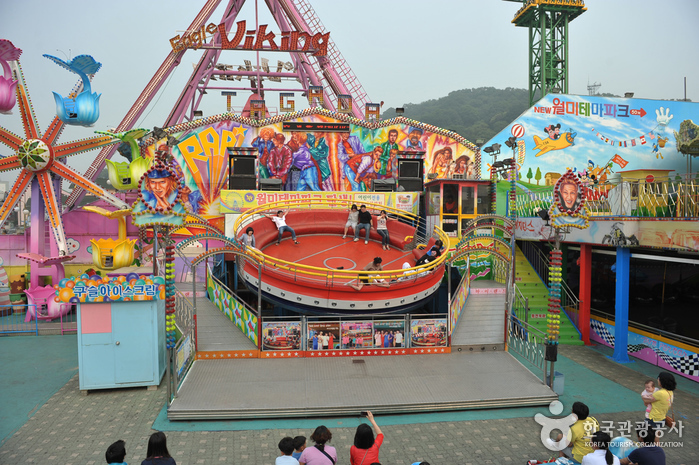
This is the part of Incheon that rewards staying over visiting on a day trip. Incheon Station — the end of Seoul Metro Line 1 — drops you directly at the gate of Korea's only real Chinatown. The streets around it have been serving hand-pulled noodles and steamed dumplings since the 1880s when Chinese merchants arrived after the port opened. A 10-minute walk gets you into the Open Port heritage district, where restored colonial-era buildings from Japanese, Chinese, and Western traders still stand. Another 20 minutes on foot reaches Wolmido, the waterfront island connected by a causeway where locals come for street food, an amusement park, and evening harbour walks.
Staying in Jung-gu puts all of this within walking distance. The tradeoff: hotel stock is older and smaller than Songdo, options are more limited, and getting to the airport takes close to an hour on transit. But for a traveller whose priority is atmosphere and authentic urban texture over modern facilities, this is clearly the right choice.
Accommodation here ranges from older business hotels near the station to smaller guesthouses tucked into the side streets of Chinatown. Prices are noticeably lower than Songdo or the airport area for comparable quality.
Book in Chinatown & Jung-gu
For food recommendations in the Chinatown area, see our Incheon Chinatown Food Directory.
Bupyeong — Budget Hub
Bupyeong is Incheon's main commercial district — not a tourist neighbourhood, but a functional one. It has the best metro connections in the city (Lines 1 and 2 intersect here), the most budget accommodation per square kilometre, and enough street food, chicken-and-beer spots, and local restaurants to eat well for a week. It is not atmospheric in the way that Chinatown is, and it lacks Songdo's polish, but for travellers who are comfortable navigating a Korean city and want to stretch their budget, it works well.
Bupyeong is also the most practical base if your Incheon itinerary includes day trips: Seoul is about 60 minutes on Line 1 from Bupyeong, Chinatown is 15 minutes, and Songdo is reachable on Line 2. You are not close to anything by foot, but you are 15–20 minutes from everything by metro.
How to Book Incheon Hotels in English
Incheon's booking infrastructure is good but not as saturated as Seoul. Some smaller guesthouses and local hotels near Chinatown only list on Korean platforms, which means international search engines miss them. Two platforms cover the most ground:
- Trip.com — the strongest overall inventory for Incheon, including near-airport hotels that sometimes do not appear on Western platforms. Accepts foreign credit cards, interface is clean in English, and inventory skews toward the mid-range that works best for most Incheon stays.
- Booking.com — best for the international chains (Marriott, Hyatt, Hilton) near the airport and in Songdo, where it has reliable inventory and review quality.
Steps:
- Decide your base first — airport area, Songdo, Chinatown, or Bupyeong — using the table above
- Search Trip.com for your area and check free-cancellation options
- Cross-reference the same property on Booking.com to compare price and review recency
- For near-airport stays specifically, confirm shuttle bus availability before booking
Price Tips & Timing
📅 Peak demand: Incheon's airport hotels spike on Korean national holidays when domestic travellers fly out. Long weekends in May (Children's Day, Buddha's Birthday) and September (Chuseok) see airport-area rates jump 40–70%. Songdo and Chinatown are less affected. Best value windows: January–February, June, mid-September after Chuseok, November–December.
Airport area pricing logic: Near-airport hotels in Incheon work differently from most Korean city hotels. Demand spikes are driven by flight schedules and Korean holiday travel rather than tourism seasons. If you are booking a layover stay, compare 2–3 properties as there is meaningful price variation even within the same area.
Songdo vs airport for transit stays: Songdo is about 30 minutes from the airport on transit and meaningfully cheaper for comparable quality. If you are not at risk of missing a flight and want somewhere nicer to sleep, Songdo wins on value. If your flight is before 7am, stay near the airport.
Chinatown weekends: The Old Incheon area gets busy with domestic day-trippers on weekends, particularly Saturday. This does not affect hotel pricing much, but it does mean Chinatown's food streets are crowded. Arriving on a weekday evening is the ideal timing to see the neighbourhood at its best.
Incheon can also serve as a lower-cost base for visiting Seoul — prices are meaningfully below Seoul equivalents at the mid-range tier, and the AREX from Incheon Station to Seoul Station runs frequently. See our full transit guide for options and timing.
FAQ
Is it worth staying in Incheon instead of Seoul?
Yes, if you are spending time in Incheon itself. The city has enough to fill two full days — Chinatown, the Open Port district, Wolmido, Songdo, and Ganghwado Island. Commuting from Seoul for all of that adds 1–2 hours of transit per day. If you are planning a dedicated Incheon itinerary, stay in Incheon. If Incheon is just an add-on to a Seoul trip, a day trip is fine. See the full travel guide for a sample itinerary.
Which area of Incheon is best for a layover?
Near the airport (Unseo / Yeongjong Island) for anything under 12 hours where you want to sleep and get back easily. Songdo for a longer layover of 12 hours or more where you want to walk around, eat well, and experience something beyond the terminal. Chinatown is also doable for long layovers — the AREX All-Stop from the airport to Incheon Station takes about 45 minutes, which is manageable if you have 8+ hours.
What is the best area to stay for visiting Wolmido?
Chinatown / Jung-gu. Wolmido is about a 20-minute walk from Incheon Station, which is the same station that serves the Chinatown area. Staying here means you can walk to Wolmido in the evening after spending the day in Chinatown and the Open Port district. Songdo and the airport area both require significant transit to reach Wolmido.
How far is Songdo from Incheon Airport?
About 30–40 minutes on the Incheon Metro Line 1, connecting to the AREX at Incheon Airport Railroad Station. By taxi it is approximately 30 minutes and ₩25,000–₩35,000. Songdo is a viable place to stay for airport trips as long as you are not catching a very early flight — the metro starts around 5:30am, which makes a 7am or later departure manageable.
Is English well understood in Incheon hotels?
In the airport area and Songdo: yes, English is standard. International chains have English-speaking staff and the area is built around international transit. In Chinatown and Bupyeong: less reliably. Most mid-range Korean business hotels will have one or two English-capable staff but do not count on fluent communication. Booking platforms with English review bases (Trip.com, Booking.com) will indicate English-friendliness in guest reviews — it is worth filtering for this when booking in the old city area.