Korean BBQ Etiquette: 12 Unwritten Rules Foreigners Should Know
Korean BBQ Etiquette: 12 Unwritten Rules Foreigners Should Know
You've seen the TikToks. You've watched the K-dramas. You're finally sitting in a Korean BBQ restaurant in Seoul, a slab of marbled beef sizzling on the grill in front of you, and you have absolutely no idea what you're doing.
Don't worry — most foreigners don't. Korean BBQ has a whole set of unspoken social rules that Koreans absorb from childhood but nobody ever explains to visitors. Some of these are about respect. Some are about not ruining the meat. And some are just practical wisdom that will make your meal ten times better.
Here are 12 unwritten rules that will save you from awkward moments — and earn you approving nods from the Korean locals at the next table.
1. The Youngest Person (Usually) Does the Grilling
In Korean culture, age hierarchy runs deep, and it extends right to the BBQ grill. Traditionally, the youngest person at the table handles the cooking. It's a form of respect — the elders relax and eat while the junior member does the labor of grilling, turning, and cutting the meat.
Now, in practice, this isn't always rigid. If someone at the table is clearly the \"grill master\" — they know the timing, they're confident with the tongs — they'll often take over regardless of age. But if you're the youngest in your group and nobody else is reaching for the tongs, that's your cue. Pick them up and start cooking.
If you're dining with Korean friends or colleagues, wait for someone to either take the lead or signal you to do it. Grabbing the tongs immediately as a foreigner can come across as either endearing (if you know what you're doing) or mildly chaotic (if you don't).
2. Don't Start Eating Before the Eldest Person
This one catches foreigners off guard constantly. When the first batch of meat comes off the grill and hits the plate, your instinct is to grab a piece immediately. Resist that urge.
In Korean dining culture, the eldest or most senior person at the table eats first. Everyone waits until they take the first bite or pick up their chopsticks before digging in. This applies to drinks too — if someone senior pours you a glass, don't drink until they've been served as well.
In a casual setting with friends your own age, this is relaxed. But in any group with an age gap or professional hierarchy, pay attention to who eats first. When in doubt, wait an extra beat. Nobody ever got in trouble for being politely patient at a Korean table.
3. Learn the Ssam Wrap — It's an Art Form
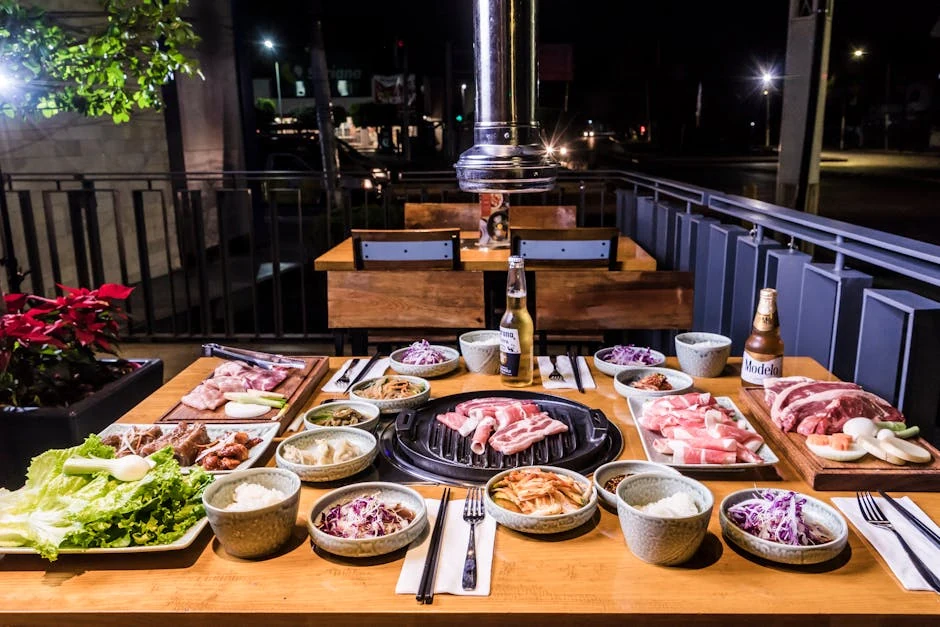
Ssam (쌈) is the technique of wrapping grilled meat in a lettuce leaf with rice, garlic, ssamjang (a thick spicy-savory paste), and whatever else strikes your fancy from the banchan spread. This is the proper way to eat Korean BBQ, and doing it well is deeply satisfying.
The Technique
- Take a leaf of lettuce (or perilla leaf, which tastes like a minty, slightly anise-flavored herb — try it) in your non-dominant hand.
- Add a small spoonful of rice as a base.
- Layer on a piece of grilled meat.
- Add a dab of ssamjang and a slice of raw garlic (or roasted garlic if you're not a garlic warrior).
- Optionally, add a strip of green onion salad (파절이) or a piece of kimchi.
- Fold the leaf around everything and eat the whole bundle in one bite.
That last point matters: you're supposed to eat the ssam in one go. Biting it in half and having rice and ssamjang dribble down your chin is the Korean BBQ equivalent of a wardrobe malfunction. If you're making your ssam too big to eat in one bite, scale down your fillings.
4. The Soju Pouring Rules Are Non-Negotiable
If there's soju on the table — and there will be — here are the rules that every Korean learns from their first company dinner:
- Never pour your own drink. Someone else pours for you, and you pour for them. This is one of the most fundamental rules of Korean drinking culture. Pouring your own soju is like shaking your own hand.
- Pour with two hands. Hold the bottle with your right hand and lightly touch your right forearm or elbow with your left hand. This gesture shows respect. The more senior the person you're pouring for, the more important this becomes.
- Receive with two hands. When someone pours for you, hold your glass with both hands or with one hand while the other touches your wrist or forearm.
- Turn away from elders when drinking. If you're drinking with someone older or more senior, turn your head slightly to the side when you take a sip. This shows you're not brazenly drinking in their face. It's a subtle gesture, but Koreans notice it — and deeply appreciate when foreigners do it.
Don't stress about getting every detail perfect. The effort alone signals respect, and most Koreans will be charmed that you know about these customs at all. If you want to dive deeper into drinking customs, check out our guide to Korean drinking culture.
5. Use the Scissors — Yes, Scissors
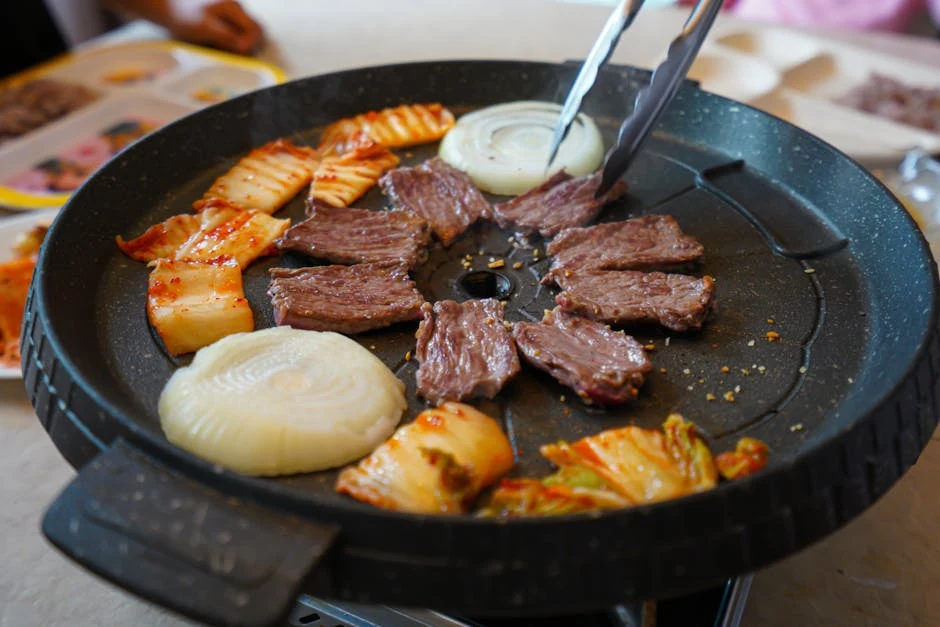
If you've never been to a Korean BBQ restaurant before, seeing the server pull out a pair of heavy-duty scissors to cut your meat on the grill can be jarring. But kitchen scissors are a standard Korean cooking tool, and at BBQ restaurants, they're the primary way to cut large pieces of meat into bite-sized portions.
Don't be shy about using them. When a piece of samgyeopsal (pork belly) or galbi (short ribs) is cooked on one side, use the scissors to cut it into manageable pieces, then flip and finish cooking. Tongs in one hand, scissors in the other — that's your BBQ toolkit.
Some higher-end restaurants (the kind where wagyu-grade hanwoo beef costs ₩80,000+ per serving) will have the staff cook and cut everything for you. At a standard BBQ joint charging ₩15,000–₩25,000 per person ($11–$18 USD), you're doing it yourself.
6. Side Dishes (Banchan) Are Free — and Refillable
This is the fact that blows every first-time visitor's mind. Those six to twelve small dishes that arrive at your table before the meat — kimchi, pickled radish, bean sprouts, japchae, egg steam, seasoned spinach — are all free. They come with every meal. And if you finish any of them, you can ask for more at no extra charge.
Just catch the server's eye (or use the bell — see Rule 7) and point to the empty dish. Say \"반찬 더 주세요\" (banchan deo juseyo — \"more side dishes please\") and they'll bring a refill. There's no limit, though emptying a dish six times in a row might get you some amused looks.
The quality and variety of banchan is actually a decent indicator of the restaurant's overall quality. If the banchan feels fresh and homemade rather than mass-produced, you're probably in a good spot. Some of the best Korean food experiences happen when a humble-looking restaurant drops twelve incredible banchan dishes before the main course even arrives.
7. Press the Bell to Call Your Server
Do not wave your hand in the air. Do not try to make eye contact across the restaurant. Do not get up and walk to the kitchen. Look at your table — there's almost certainly a small button, usually on the wall or on the table surface, that buzzes the staff.
Press it. A server will come to you. This is the Korean restaurant system, and it's honestly superior to the Western model of servers periodically checking on you. You get attention when you want it and peace when you don't. The button might look like a small doorbell, or it might be embedded in a tablet ordering system. In some newer restaurants, you order entirely from a touchscreen.
In the rare case there's no button, calling out \"저기요!\" (jeogiyo — roughly \"excuse me!\") in a clear, firm voice is perfectly acceptable. It's not rude; it's expected.
8. Don't Tip — Seriously, Don't
This is one piece of Korean etiquette that foreigners are usually happy to follow. Tipping is not a thing in South Korea. Not at restaurants, not at bars, not at hotels (with rare exceptions at very high-end international hotels), not in taxis. The price on the menu is the price you pay, and servers are paid a proper wage.
Leaving money on the table after a BBQ meal might actually cause confusion — the server may chase you down the street thinking you forgot your change. If the service was genuinely exceptional and you want to show appreciation, a sincere \"맛있었어요\" (mashisseosseoyo — \"it was delicious\") and a bow means more than cash.
9. Ordering Is a Group Decision
At Korean BBQ, you don't order individual portions like at a Western steakhouse. The group orders together — usually a set amount of meat measured in servings (인분, inbun). One inbun is one serving, typically 150–200 grams of meat.
The standard formula: order one serving per person to start, then add more as needed. For a table of four, you'd start with \"사 인분 주세요\" (sa inbun juseyo — \"four servings please\"). Most restaurants require a minimum of two servings per meat type.
It's also common (and smart) to order a mix: maybe two servings of samgyeopsal (pork belly, ₩12,000–₩15,000 per serving), two of moksal (pork neck, slightly more marbled, similar price), and if you're feeling flush, a serving of chadolbaegi (thinly sliced beef brisket, ₩18,000–₩22,000). A meal for two at a solid neighborhood BBQ joint typically runs ₩30,000–₩50,000 total ($22–$36 USD) including rice and stew.
10. Don't Neglect the Doenjang Jjigae at the End
After the meat is gone and the grill is cooling, most tables order a stew to close out the meal. Doenjang jjigae (fermented soybean paste stew) and kimchi jjigae are the two most popular choices. Some restaurants include one automatically with your order.
This isn't just tradition — it's practical. After all that rich, fatty grilled meat, a hot, brothy stew with rice settles your stomach perfectly. Many Koreans consider the stew the \"real\" ending to a BBQ meal. Skipping it is like leaving a movie before the last scene.
You'll also sometimes see people making \"fried rice\" on the grill using the leftover meat juices, bits of kimchi, rice, and sesame oil. If your server offers to make this for you, say yes immediately. It's one of the best bites of the entire meal.
11. One Person Pays (Usually)
Splitting the bill evenly at Korean BBQ is becoming more common among younger Koreans, but the traditional custom is that one person covers the entire meal. This is usually the eldest person, the person who initiated the gathering, or in a work context, the boss.
If a Korean friend or colleague insists on paying, accept graciously after one or two polite protests. Fighting too hard over the bill is awkward. The understanding is that you'll get the next one — and that reciprocity is taken seriously.
When you do pay, note that most Korean BBQ restaurants handle payment at a register near the entrance, not at the table. You'll walk up to the counter with the bill (your table number is on it) and pay there. Credit cards are accepted virtually everywhere, and many places take Samsung Pay and KakaoPay.
12. The Smell Stays With You — Plan Accordingly
This is the practical tip that no etiquette guide mentions but everyone learns the hard way. After Korean BBQ, you will smell like grilled meat and smoke. Your clothes, your hair, your jacket — everything. Koreans know this, which is why many restaurants have coat hooks away from the grill area or offer plastic bags for your jacket.
Some things that help:
- Wear clothes you don't mind getting smoky. Don't wear your nicest outfit to a BBQ dinner.
- Use the coat hooks or bags the restaurant provides. Drape your jacket over the back of your chair at your own peril.
- Keep a travel-sized fabric spray (Febreze or similar) in your bag. Koreans do this routinely.
- Plan BBQ for later in the evening so you're heading home afterward, not into another social situation smelling like a smokehouse.
This is also why many Korean BBQ restaurants have powerful ventilation hoods over each table. The fancier the restaurant, the better the ventilation. The cheapest, most delicious hole-in-the-wall spots? You're leaving there marinated in smoke. Worth it every time.
Where to Try Korean BBQ in Seoul
A few recommendations to get you started:
- Mapo Jeong Daepo (마포정대포) — Mapo-gu. Legendary for pork BBQ. Order the moksal. Cash only. Expect a wait on weekends. Around ₩13,000 per serving.
- Yukjeon Hoekwan (육전회관) — Jung-gu, near Seoul Station. Iconic galbi since 1966. Pricier (₩35,000+ per serving for beef), but a classic experience.
- Geonbae BBQ (건배) — Multiple locations. Affordable all-you-can-eat option popular with younger Koreans. Around ₩18,000 per person for unlimited pork and chicken.
- Wangbijib (왕비집) — Mapo-gu. Another outstanding pork belly spot in the same neighborhood as Mapo Jeong Daepo. Great for a second visit when the first one has a 45-minute wait.
For more restaurant recommendations, see our complete guide to the best Korean food for foreigners.
Frequently Asked Questions
Is Korean BBQ always self-service grilling?
Mostly, yes — at standard BBQ restaurants you grill the meat yourself at your table. However, some higher-end spots (especially hanwoo beef specialists) have staff who cook for you. If a server starts placing meat on the grill and motioning for you to wait, let them handle it. They know the perfect timing for their cuts.
Can I go to Korean BBQ alone?
It's possible but uncommon. Most BBQ restaurants have a minimum order of two servings, and the whole setup is designed for groups. That said, \"1-person BBQ\" restaurants (혼밥 고기집) have become increasingly popular in Seoul. These have individual grills and single-serving portions. Look for signs saying 1인분 가능 (1 inbun ganeung — \"single serving available\").
What if I don't drink alcohol?
Completely fine. While soju and beer flow freely at most Korean BBQ dinners, nobody will pressure you to drink if you decline. Soft drinks (Coca-Cola, Chilsung Cider — Korea's answer to Sprite) are available everywhere, and simply saying \"저는 안 마셔요\" (jeoneun an mashyeoyo — \"I don't drink\") is respected without question.
Is Korean BBQ halal or kosher?
Standard Korean BBQ is neither halal nor kosher. Pork is the most common meat, and beef is not typically slaughtered according to halal or kosher practices. However, Seoul does have a small number of halal-certified Korean BBQ restaurants, mostly in the Itaewon area near the Seoul Central Mosque. Search for \"halal Korean BBQ\" on Naver Map for current options.
How do I say \"delicious\" in Korean?
\"맛있어요\" (mashisseoyo). This is probably the single most useful Korean word you'll learn. Say it with enthusiasm after your meal and watch your server smile. If you want to level up, try \"정말 맛있었어요\" (jeongmal mashisseosseoyo — \"it was really delicious\") when you're paying at the register.
The Bottom Line
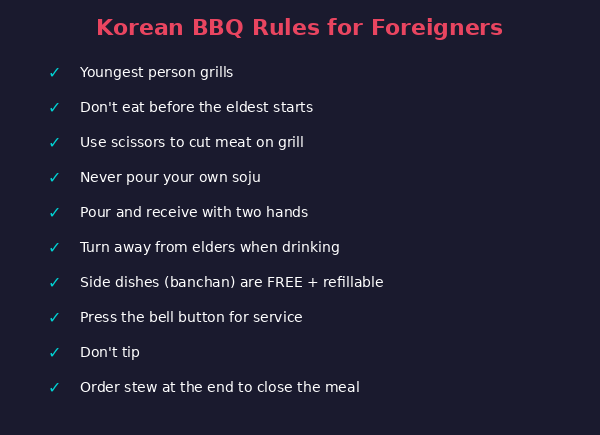
Korean BBQ isn't just a meal — it's a social ritual. The grilling, the pouring, the wrapping, the shared dishes — all of it is built around the idea of eating together as a communal experience. You don't need to follow every rule perfectly. Koreans are genuinely warm toward foreigners who make an effort, and even a clumsy attempt at the soju pour or the ssam wrap will earn you goodwill.
The only real mistake is being too self-conscious to try. Get in there, burn a few pieces of meat, make a ssam that falls apart, pour soju with the wrong hand, and laugh about it. That's what Korean BBQ is actually about.
Ready to plan your Korean food adventure? Check out our first-timer's guide to Korea for everything you need to know before you go. And follow Korea Insider for weekly tips on eating, exploring, and living your best life in South Korea.