Korea Fall Foliage 2026 — Best Spots + Peak Dates by Region
Korea's autumn is one of East Asia's great seasonal spectacles — and one of the most reliably timed. Unlike Japan's cherry blossom season, which shifts by a week or more year to year, Korean fall foliage follows a predictable north-to-south pattern that makes it easier to plan around. Seoraksan in the northeast turns first, usually by mid-October. Seoul and the midlands peak through late October and early November. Jeju, the southernmost island, holds its colour into late November.
The country's mountain-heavy terrain amplifies everything. Colours are vivid — deep reds and oranges against granite peaks, golden gingko lining temple courtyards, maple valleys so dense with colour that the light changes as you walk through them. And because most Koreans travel domestically for foliage, the best sites have good transport links, decent accommodation, and the kind of organised trail infrastructure that makes a half-day hike genuinely accessible.
This guide covers when foliage peaks by region, the ten spots worth visiting, and how to put a trip together without spending your whole stay on a bus.
When Does Fall Foliage Peak in Korea?
Korean autumn follows the mountains. The first colour appears at high elevations in the northeast — Seoraksan's summit ridge turns by late September, with valley floors catching up through the first half of October. The wave then spreads south and west through October, reaching Seoul's urban parks and Gyeongju's ancient sites in early November. Jeju closes the season in the second and third weeks of November.
The pattern is consistent enough that most Koreans plan foliage trips weeks in advance, and the most popular sites — Naejangsan in particular — become genuinely crowded on peak weekends. If you're flexible on dates, mid-week visits in the second week of your target window typically offer better conditions than weekends.
2026 Quick Reference
- First colour: Seoraksan upper slopes, late September
- Peak nationwide: late October–early November
- Last to peak: Jeju, mid-to-late November
- Best single week: November 1–7 (covers Seoul, Gyeongju, Naejangsan simultaneously)
Peak Dates by Region — 2026 Table
Dates are approximate based on historical averages. Actual timing can shift by 5–7 days depending on September and October temperatures. A warm September delays onset; an early cold snap accelerates it.
| Region / Spot | Peak Window | Best Single Week | Notes |
|---|---|---|---|
| Seoraksan (Sokcho) | Oct 12–25 | Oct 15–22 | Earliest in Korea; reds + oranges dominate |
| Naejangsan (Jeongeup) | Oct 28–Nov 12 | Nov 1–8 | Densest maple canopy in Korea; very popular |
| Seoul (Namsan, Bukhansan) | Oct 28–Nov 12 | Nov 1–8 | Gingko lines city streets; mountain reds later |
| Gyeongju | Nov 3–18 | Nov 5–12 | Bomun Lake, Tumuli Park, temple grounds |
| Nami Island | Oct 25–Nov 10 | Oct 28–Nov 4 | Iconic gingko + maple avenues; day trip from Seoul |
| Jirisan | Oct 20–Nov 5 | Oct 25–Nov 1 | Slower-burning reds; less crowded than Seoraksan |
| Garden of Morning Calm | Oct 25–Nov 10 | Oct 28–Nov 4 | Curated garden; Autumn Flower Festival runs Oct–Nov |
| Songnisan / Beopjusa | Oct 22–Nov 8 | Oct 28–Nov 3 | Golden valley + temple setting; less touristy |
| Jeju | Nov 8–22 | Nov 10–17 | Hallasan upper slopes first; longer season than mainland |
Top 10 Fall Foliage Spots in Korea
1. Seoraksan National Park (Sokcho)
Seoraksan is where Korean autumn starts. The park's granite peaks and deep river valleys in Gangwon Province create conditions for an early, intense display — reds and oranges against bare rock faces that have no equivalent elsewhere in the country. The inner park (Naerincheon valley) and the Biseondae trail are the most photographed circuits. A cable car from Sogongwon to the ridge saves altitude for those who want the views without the climb.
Best access: Express bus from Seoul's East Seoul Bus Terminal to Sokcho (~2.5 hours). Local bus from Sokcho terminal to the park gate.
Entry: ₩3,500 (national park fee)
Cable car: ₩13,000 round trip
Stay nearby: Sokcho has a full range of guesthouses and business hotels within 20 minutes of the park gate.
Guided day tours from Seoul covering Seoraksan are available on Klook — useful if you want to avoid the bus logistics and arrive with a guide who knows which trails are at peak. Book a Seoraksan day tour from Seoul on Klook.
2. Naejangsan National Park (Jeongeup)
For sheer density of colour, Naejangsan is the benchmark. The park's main valley — Naejang Valley — is lined with thousands of maple trees whose canopy closes overhead on the main walking trail. When it peaks in late October and early November, the effect is a tunnel of deep red and orange that draws visitors from across the country. This also makes it extremely crowded on weekends.
The cable car to the ridge above the valley offers a different perspective — the mosaic of colour seen from above against the surrounding farmland is a different kind of spectacle from the valley walk. Allow at least half a day; a full day is better if you plan to combine the valley circuit with the ridge trail.
Best access: KTX from Seoul to Jeongeup (~1.5 hours), then local bus or taxi to the park (~20 minutes).
Entry: ₩3,000
Cable car: ₩10,000 round trip
Tip: Book accommodation in Jeongeup at least 2–3 weeks ahead for peak weekends.
3. Bukhansan + Namsan (Seoul)
Seoul's foliage is underrated. The city's two main hiking mountains — Bukhansan on the northern edge of the metropolitan area and Namsan at the centre — both offer solid autumn colour within a subway ride of any hotel. Bukhansan's granite ridge trails mix rocky terrain with maple slopes; Namsan's circular walking trail around N Seoul Tower is more accessible and overlooks the city.
In the city itself, gingko trees lining the streets of Yeongdong-daero, Doksugung's stone wall path (Deoksugung Doldam-gil), and the canal walk along Cheonggyecheon all turn gold in late October. For the full urban autumn experience, a mid-morning walk from Gyeongbokgung through Bukchon to the Changdeok Palace Secret Garden is one of the better ways to spend a Seoul autumn morning.
Bukhansan access: Subway Line 3 to Gupabal Station, then bus to the Baegundae trailhead.
Namsan access: Seoul City Tour Bus, taxi, or cable car from Myeongdong.
Best street gingko: Yeongdong-daero (Coex area), last week of October.
4. Nami Island (Namiseom)
Nami Island is the most widely photographed autumn destination in Korea — its signature avenues of tall gingko and maple trees framing straight paths across the island have appeared on travel posters and TV dramas for years. The island itself is small enough to walk across in under an hour, but the density of planted trees and the deliberate landscaping mean the foliage experience is concentrated and accessible in a way that national parks are not.
It is busy. October weekends especially bring large crowds, and the ferry queue from Gapyeong can back up. Mid-week visits in early November, as the last of the leaves drop, are quieter and still beautiful.
Best access: ITX train from Seoul Cheongnyangni to Gapyeong (~1 hour), then local bus or taxi to the ferry pier (~20 minutes).
Entry: ₩16,000 (includes ferry both ways)
Day tour option: Nami Island day tours from Seoul on Klook typically combine the island with Petite France and/or the Garden of Morning Calm — good value if you want to cover multiple sites in one day without hiring a car.
5. Gyeongju (Bomun Lake + Tumuli Park)
Gyeongju's autumn is subtle but memorable. The city's abundance of open parkland, ancient burial mounds, and temple grounds means that autumn colour appears across the cityscape rather than concentrated in a single valley. Bomun Lake's walking circuit in early November is particularly good — gingko and maple trees ring the lake against the backdrop of traditional resort buildings. Tumuli Park's grassy mounds take on a golden cast as the surrounding trees turn.
Combining a Gyeongju foliage visit with a night in the city rather than a day trip gives you access to Bulguksa and Seokguram in the early morning, which have their own autumn colour on the forested mountain trails.
Best access: KTX from Seoul to Singyeongju (~2 hours) or express bus from Busan (~1 hour). See our full Gyeongju Travel Guide for getting around options.
Accommodation: Browse Gyeongju hotels on Booking.com.
6. Jirisan National Park
Jirisan is Korea's largest national park by land area and one of its least-visited by international travellers. The mountain — the tallest on the mainland at 1,915m — produces a long, slow foliage season that starts at the peak and descends over three to four weeks. The Baemsagol Valley on the western side of the park is one of the most scenic autumn valleys in Korea, lined with maple and oak trees along a gentle stream trail.
Getting to Jirisan takes more planning than the day-trip options above, but the reward is fewer crowds and a more genuine mountain experience. Base yourself in Gurye or Hadong for Baemsagol, or in Namwon for the northern side of the park.
Best access: Express bus from Seoul Nambu Terminal to Gurye (~3.5 hours).
Entry: ₩3,500
7. Hwadam Botanic Garden (Gapyeong)
Hwadam is a private botanic garden in Gapyeong county — the same area as Nami Island — designed specifically for aesthetic effect across all four seasons. In autumn, the combination of Korean maples, gingko trees, and ornamental plantings creates a more curated and photogenic display than wild mountain trails. It's smaller and calmer than Naejangsan, and the garden's deliberate composition makes it easier to photograph.
Hwadam pairs naturally with Nami Island on the same day trip from Seoul. The Garden of Morning Calm is a few kilometres away and can be added as a third stop.
Best access: ITX to Gapyeong, then taxi (~15 minutes).
Entry: ₩11,000
8. Achasan + Olympic Park (Seoul)
Two accessible options for autumn colour within Seoul's city limits that don't require an early start or hiking gear. Achasan is a small mountain on the eastern edge of Seoul — the summit trail takes about an hour from the base and offers good views of the Han River with autumn trees in the foreground. Olympic Park, built for the 1988 Games, has extensive planted grounds with maple and gingko that peak around the same time as the rest of Seoul.
Both work well as afternoon options if you've already done a main site in the morning, or as alternatives for visitors who find Bukhansan's ridge trails too demanding.
Achasan access: Subway Line 5, Achasan Station.
Olympic Park access: Subway Line 5 or 9, Olympic Park Station.
Entry: Both free.
9. Garden of Morning Calm (Gapyeong)
The Garden of Morning Calm runs an Autumn Flower Festival from October through November, adding chrysanthemum and autumn flower displays to the estate's existing maple and gingko plantings. The garden is more formal and ornamental than a national park, and entry tickets are priced accordingly, but the maintained grounds photograph well and the festival atmosphere adds a different dimension to a standard foliage visit.
Best access: ITX to Gapyeong, then local shuttle bus or taxi (~20 minutes).
Entry: ₩11,000 (festival pricing varies)
Hours: 08:30–17:30 (extended on weekends in peak season)
10. Songnisan National Park + Beopjusa Temple
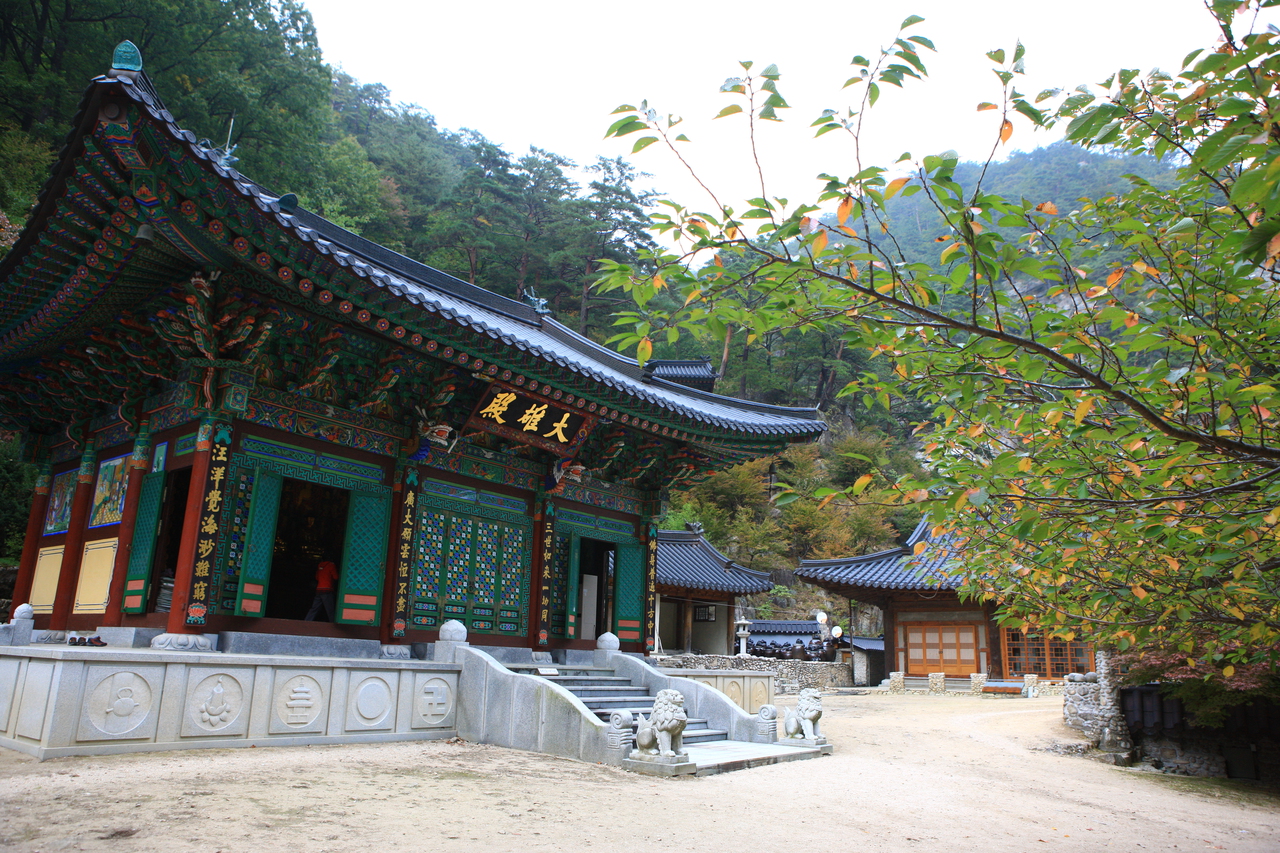
Songnisan in North Chungcheong Province is one of Korea's most visited temples on a normal day — Beopjusa, a major Buddhist complex within the park, draws visitors year-round. In autumn it becomes something different: the 1km approach road from the park gate to the temple is lined with maple trees that arch overhead, and the valley surrounding the temple complex turns deep red and orange through late October and early November.
The scale of Beopjusa is worth noting — the main hall is one of the largest wooden buildings in Korea, and the 33m bronze Buddha statue beside it creates an unusual juxtaposition with the autumn canopy. Combined with Songnisan's ridge trails, this makes for a full day visit rather than a quick stop.
Best access: Express bus from Seoul's Gangnam or Central Bus Terminal to Songnisan (~2 hours).
Entry: ₩4,000
Stay nearby: Browse accommodation near Songnisan on Booking.com.
How to Plan a Korea Foliage Trip
Transport Strategy
Korea's intercity transport network is well-suited to foliage travel. KTX connects Seoul to Gyeongju, Jeongeup (for Naejangsan), and other major cities quickly. For Seoraksan, Sokcho is the base — express buses from Seoul's East Bus Terminal run frequently and cost around ₩20,000 one way. For Nami Island and Gapyeong, the ITX Cheongchun train from Seoul is the most convenient option.
A rental car gives flexibility for Jirisan and Songnisan, which are harder to reach by public transport. International driving licences are accepted in Korea; driving is on the right side, and most highway toll systems support rental car billing directly.
Accommodation Timing
Book accommodation for peak foliage weekends (late October and the first two weekends of November) 3–4 weeks in advance. The most popular bases — Sokcho for Seoraksan, Jeongeup or nearby cities for Naejangsan — fill up quickly on the main October and November weekends. Mid-week stays are generally available with less advance notice.
Accommodation Booking Links
- Sokcho hotels on Booking.com (Seoraksan base)
- Jeongeup hotels on Booking.com (Naejangsan base)
- Gyeongju hotels on Booking.com
- Seoul hotels during peak foliage on Booking.com
Suggested 7-Day Foliage Itinerary (Late October–Early November)
| Day | Location | Highlights |
|---|---|---|
| Day 1–2 | Seoul | Namsan, Deoksugung stone wall path, gingko avenues |
| Day 3 | Gapyeong (day trip) | Nami Island + Garden of Morning Calm |
| Day 4 | Jeongeup / Naejangsan | Maple valley walk, cable car, overnight in Jeongeup |
| Day 5–6 | Gyeongju | Bomun Lake, Bulguksa, Tumuli Park, overnight |
| Day 7 | Return to Seoul | Bukhansan morning hike, evening flight |
What to Wear
October days in Korea are comfortable — 10–18°C on mainland, warmer in Jeju. Evenings drop quickly after sunset; 5–10°C overnight is common by late October in northern regions. A mid-weight jacket and layers are sufficient for daytime hiking. November mornings are colder (often below 5°C at mountain trailheads), and light gloves and a wool layer are worth packing.
Photography Tips for Korean Fall Foliage
Shoot in the first two hours after sunrise. The low-angle light in Korean autumn mornings is exceptional — it hits valley floors horizontally and catches the red maple leaves from the side rather than overhead. This window also avoids the crowds that build from around 09:30 on weekends.
Overcast days are underrated. Direct sun creates high contrast that's difficult to expose correctly in dense forest. Light cloud cover produces softer, more even tones and allows the colours to saturate naturally. Many Korean foliage photographers prefer drizzly mornings for this reason.
Use a telephoto to compress layers. Mountain foliage scenes at Seoraksan and Jirisan benefit from compression — a 70–200mm lens (or equivalent) brings distant ridgelines into the same focal plane as foreground leaves, creating a depth of colour that wide-angle shots can't reproduce.
Gingko timing is tight. Gingko trees turn yellow quickly and drop fast — the full yellow display typically lasts four to seven days at any given location. Check conditions before travelling specifically for gingko rather than using the general maple peak dates.
Nami Island is best mid-week, afternoon. The famous gingko avenues photograph cleanly when the crowds thin out. Late afternoon light from the west catches the yellow leaves and the long shadows of the tree avenues in the same frame.
FAQ
When is the best time to see fall foliage in Korea?
The single best week for covering the most ground is November 1–7. This window catches Naejangsan, Seoul, Nami Island, and the beginning of the Gyeongju season simultaneously. If you can only travel earlier, late October (24–31) is excellent for Seoraksan and the Gapyeong area.
Which Korean city is best for autumn leaves?
Jeongeup (gateway to Naejangsan) for the densest single display; Seoul for the combination of urban colour and accessible mountain trails; Sokcho for the earliest and most dramatic mountain foliage at Seoraksan.
Is Seoraksan worth it for fall foliage?
Yes — it's the most dramatic foliage landscape in Korea, combining granite peaks with deep reds and oranges not found at other sites. It's worth the journey if you can hit the October 15–22 window. Outside that window, the display drops off quickly.
How crowded is Korean fall foliage season?
Busy but manageable mid-week. Naejangsan on peak weekends (first two weekends of November) is genuinely crowded — trail queues, full parking, and long cable car waits are normal. Seoraksan is less crowded than Naejangsan on the same weekends. All sites are substantially quieter Monday–Thursday.
Can I combine Korea foliage with Japan autumn travel?
Possible but tight — Japan's autumn runs slightly later (Kyoto peaks mid-to-late November). A trip anchored in Korea's first week of November, then transiting to Japan for the following two weeks, is a viable circuit. Budget flights connect Seoul to Osaka, Tokyo, and Fukuoka daily.
---Related guides: Korea in October 2026 | Best Hiking Trails in Korea | Gyeongju Travel Guide | Where to Stay in Daegu